China Pharmaceutical University Huang Fengjie Team Finds That Sinomenine Modulates Sepsis-Induced Metabolic Reprogramming via CHRNA7
Custom AAV6-shCHRNA7 | China Pharmaceutical University Huang Fengjie Team Reveals How Sinomenine Modulates Sepsis-Induced Metabolic Reprogramming via CHRNA7 (Life Sciences)
Paper title: Sinomenine modulates the metabolic reprogramming induced by sepsis via CHRNA7
Journal: Life Sciences
Collaborating partner: China Pharmaceutical University, Huang Fengjie team
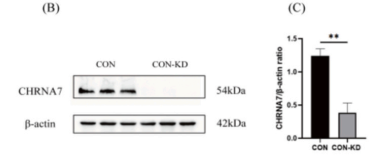
AAV6-shCHRNA7 significantly knocks down CHRNA7 expression
Research Background
Sepsis is a disease that can cause systemic inflammation and metabolic reprogramming, with high morbidity and mortality. Previous studies have shown that sinomenine (SIN) can alleviate sepsis by reducing inflammation, but its effect on metabolic reprogramming remains unclear. Recently, the team of Huang Fengjie at China Pharmaceutical University published the paper Sinomenine modulates the metabolic reprogramming induced by sepsis via CHRNA7 in Life Sciences, finding that SIN interacts with CHRNA7 to restore glycolysis and glutamine replenishment, thereby mediating metabolic reprogramming and alleviating sepsis. This study clarifies the mechanism by which SIN alleviates sepsis from a metabolic perspective.
Research Results
1. SIN affects metabolism in septic mice through interaction with CHRNA7
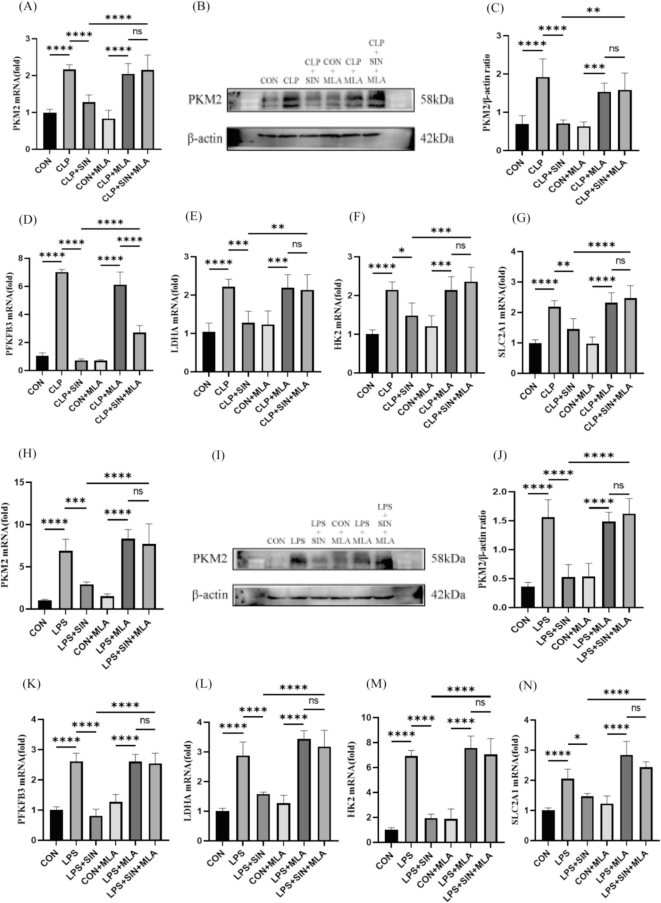
Metabolomics studies showed that SIN can affect energy metabolism, particularly glucose metabolism, and that this effect may be related to the activation of CHRNA7. Next, the authors explored the role of SIN and CHRNA7 in the metabolism of septic mice. By detecting the expression of glycolytic markers in lung tissue of septic mice and in LPS-stimulated macrophages, they found that SIN inhibits glycolysis via CHRNA7. They further detected the expression of PPP, hexose-6-phosphate dehydrogenase (H6PD) and phosphogluconate dehydrogenase (PGD) rate-limiting enzymes in lung tissue of septic mice and LPS-stimulated macrophages; the results showed that SIN inhibits ROS production via CHRNA7 and suppresses oxidative stress by affecting the PPP via CHRNA7. In addition, SIN restores glutamine replenishment in lung tissue and macrophages of septic mice via CHRNA7.
Figure 1 SIN inhibits the expression of key glycolytic enzymes via CHRNA7
2. Downregulation of CHRNA7 suppresses the restorative effect of SIN on metabolic reprogramming in septic mice
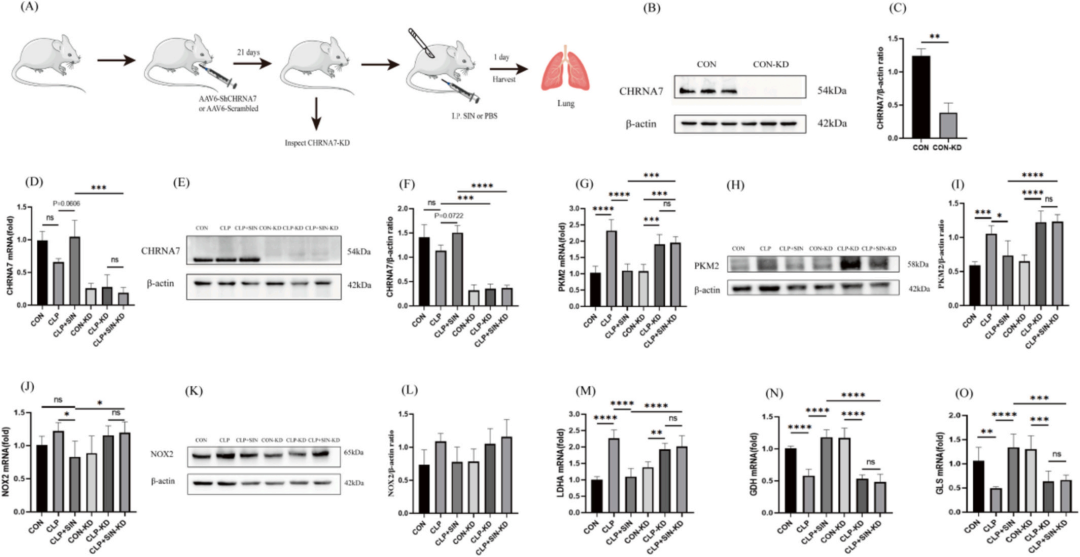
To further investigate the effect of lung-specific CHRNA7-KD on SIN treatment of sepsis, the authors used AAV6 to knock down CHRNA7 expression in mouse lung tissue. To study the effect of CHRNA7 knockdown on septic metabolic reprogramming, they examined the expression of metabolism-related genes and found that the expression of LDHA and PKM2 was significantly increased in the lung tissue of CLP group mice and significantly reduced after SIN treatment. However, knockdown of the CHRNA7 gene reversed the therapeutic effect of SIN, indicating that SIN may affect glycolysis through CHRNA7. The expression of NOX2 did not change significantly, indicating that SIN may not directly affect the PPP in CLP mice. The mRNA levels of GLS and GDH were significantly decreased in CLP mice, then significantly increased after SIN treatment, and remained at a low level after CHRNA7-KD, indicating that SIN can restore glutamine replenishment through CHRNA7. The authors administered SIN to mice in the CON group and examined the expression of metabolism-related genes; the results showed no significant changes in metabolism-related genes between the SIN and CON groups, indicating that SIN has no direct effect on metabolism.
Figure 2 Downregulation of CHRNA7 suppresses the restorative effect of SIN on metabolic reprogramming in septic mice
Conclusions
Based on metabolomic analysis, this study demonstrates that the effect of SIN on the metabolic state of septic mice is related to glucose metabolism and amino acid metabolism, and predicts that the mechanism is related to the activation of CHRNA7. In vivo and in vitro experiments using KD mice and macrophages both showed that SIN activates CHRNA7 to mediate metabolic reprogramming, including glycolysis, glutamine synthesis and PPP branch metabolic processes, thereby alleviating sepsis. These new findings reveal the molecular mechanism of SIN in the treatment of sepsis from a metabolic perspective.