IF 17.3 | Yi Cong / Zou Wei / Feng Du / Huang Yunpeng / Mei Kunrong teams identify Rpl12 as a conserved ribophagy receptor
rAAV9-RPL12 Custom | Zhejiang University Yi Cong / Zou Wei teams reveal Rpl12 as a conserved ribophagy receptor (Nature Cell Biology, IF 17.3)
Paper title: Rpl12 is a conserved ribophagy receptor
Journal: Nature Cell Biology (IF 17.3)
Collaborating partner: Zhejiang University – Yi Cong and Zou Wei teams, in collaboration with Guangzhou Medical University (Feng Du team), Hangzhou Institute for Advanced Study, UCAS (Huang Yunpeng team) and Tianjin University (Mei Kunrong team)
Ribosome turnover is a vital cellular process that allows cells to adapt rapidly to environmental changes and survive in an optimal manner, and autophagy plays a key role in ribosome turnover. In mammals, NUFIP1 has been identified as a starvation-induced ribophagy receptor, but studies have shown that under glutamine deprivation NUFIP1 participates in rRNA degradation rather than ribosomal protein degradation in mouse cancer-associated fibroblasts, suggesting that other receptors may also participate in ribosome turnover. Recently, the Yi Cong and Zou Wei teams at Zhejiang University, the Feng Du team at Guangzhou Medical University, the Huang Yunpeng team at the Hangzhou Institute for Advanced Study, UCAS, and the Mei Kunrong team at Tianjin University published the paper Rpl12 is a conserved ribophagy receptor in Nature Cell Biology (IF 17.3), reporting that Rpl12 is a conserved ribophagy receptor essential for ribosome metabolism and cellular homeostasis.
Research Results
1. Atg1-mediated phosphorylation of Rpl12 triggers ribophagy
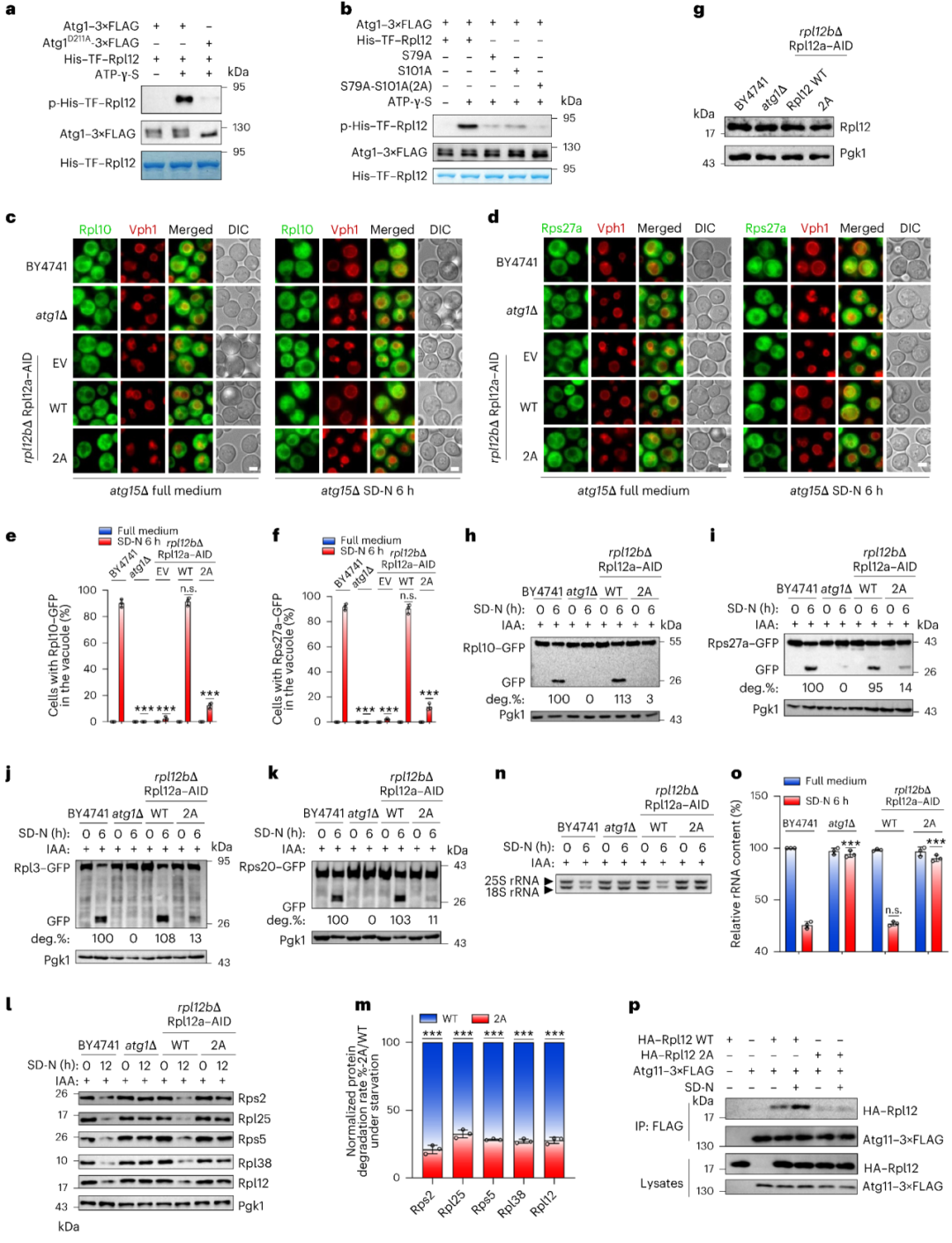
The authors found that Rpl12 acts as a receptor for yeast ribophagy during the starvation response, and further explored the signalling pathway that initiates ribophagy. In vitro kinase assays showed that Atg1 can phosphorylate Rpl12. MS analysis and in vitro kinase assays further indicated that Ser79 and Ser101 are the targets of Atg1-mediated Rpl12 phosphorylation. The authors then assessed whether Atg1-mediated Rpl12 phosphorylation is required for ribophagy. Western blot analysis confirmed that Rpl10–GFP and Rps27a–GFP produced almost no free GFP in these cells, whereas WT Rpl12 restored free GFP production. Similarly, the Rpl12 2A mutation suppressed the production of free GFP from GFP-tagged ribosomal proteins under starvation conditions. Moreover, degradation of endogenous ribosomal proteins and rRNA was inhibited in yeast cells carrying the Rpl12 2A mutation. These results indicate that Atg1-mediated Rpl12 phosphorylation is required for ribophagy. Further study revealed that Atg1-mediated Rpl12 phosphorylation triggers ribophagy by enhancing its binding to Atg11 under starvation conditions.
Figure 1 Atg1-mediated phosphorylation of Rpl12 triggers ribophagy
2. Ribophagy is essential for cell survival during starvation
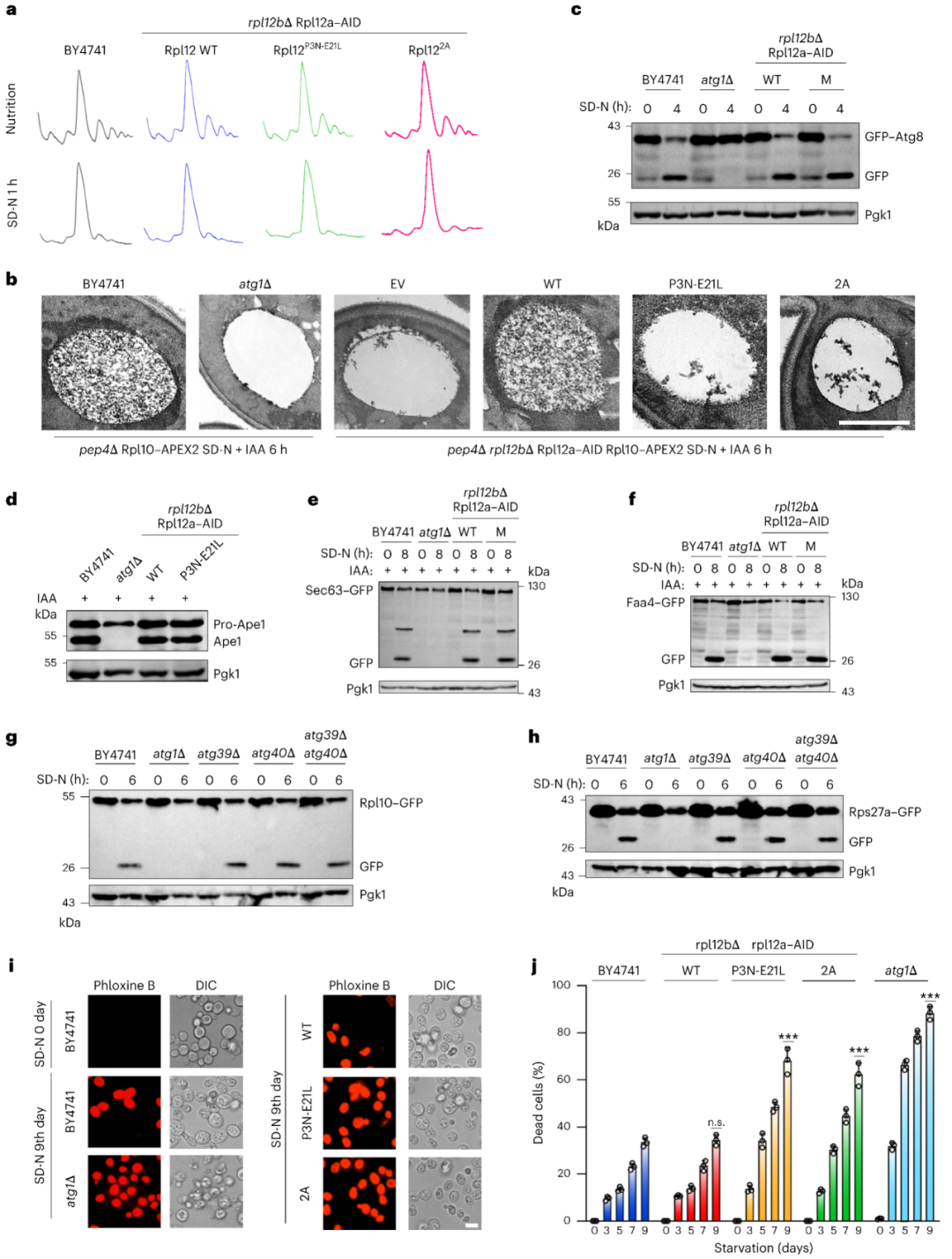
The authors further investigated the function of Rpl12 in ribophagy and found that the Rpl12 P3N-E21L and Rpl12 2A mutations block ribophagy by impairing their binding to Atg8 or Atg11, rather than by affecting ribosomal function. The authors also examined whether Rpl12 acts in other autophagic processes. Western blot analysis showed that the Rpl12 P3N-E21L mutation did not affect maturation of the Ape1 precursor, nor cleavage of marker proteins associated with selective autophagy, indicating that Rpl12 is not involved in these processes and highlighting its specific role as a ribophagy receptor. Because ribosomes bind to the ER for mRNA translation, the authors investigated whether ribophagy is affected by loss of ER autophagy and found that ribophagy is independent of reticulophagy. The authors then assessed whether ribophagy contributes to cell survival, and the results showed that the Rpl12 P3N-E21L and 2A mutations significantly increased starvation-induced cell death. These data highlight the critical role of ribophagy in maintaining cell survival during starvation.
Figure 2 Ribophagy is essential for cell survival during starvation
3. RPL12 is a conserved ribophagy receptor in mammals
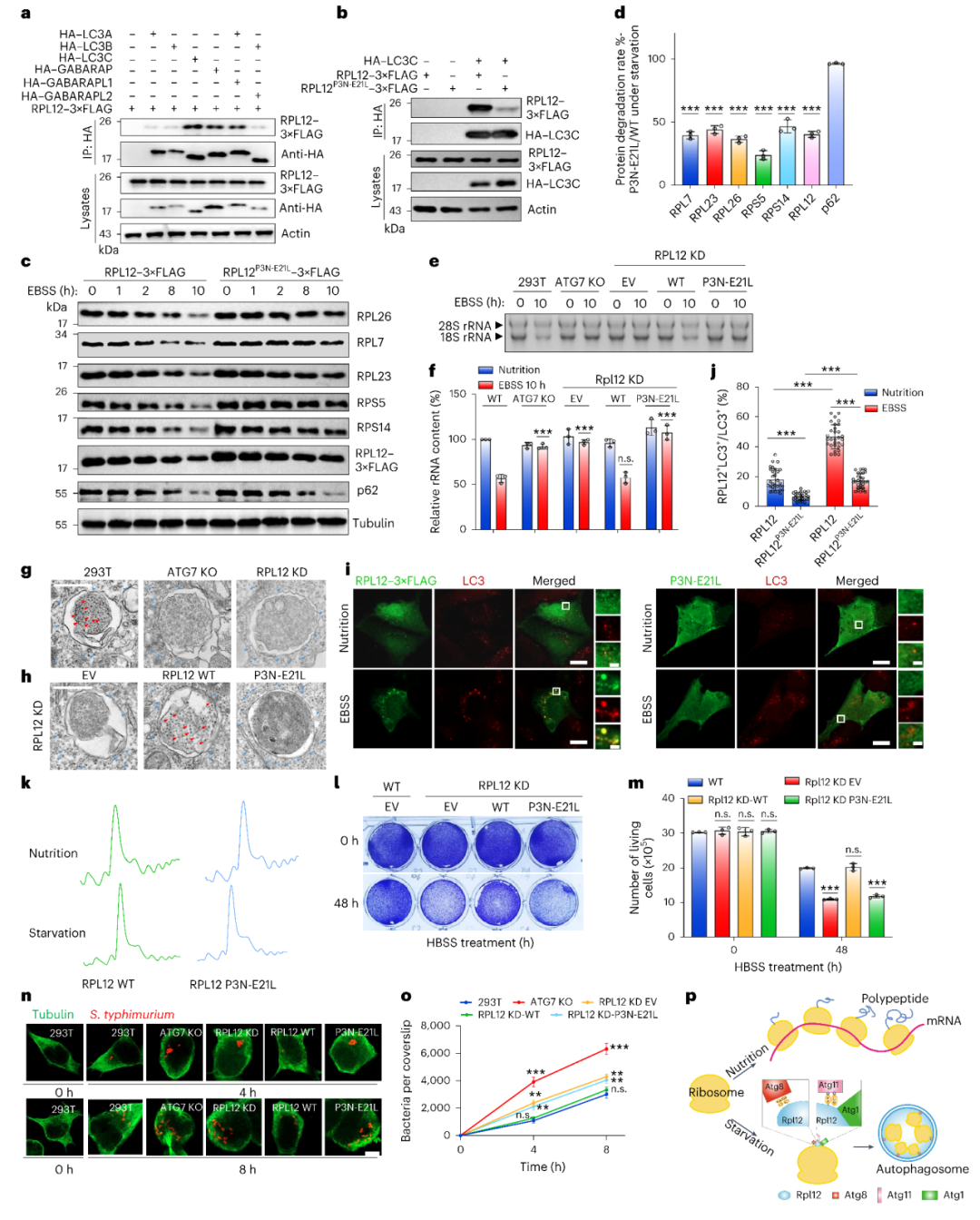
The authors investigated whether RPL12 is required for cell survival under starvation. The results of clonogenic survival assays and direct cell counting showed that RPL12 knockdown, or loss of its ability to bind Atg8s, reduced cell survival under nutrient deprivation, and bacterial infection assays demonstrated that ribophagy contributes to autophagy-mediated suppression of bacterial replication. To test whether RPL12 regulates hepatic ribophagy in mice, the authors expressed RPL12 or RPL12-P3N-E21L in mice via AAV and found that, compared with wild-type RPL12, the RPL12-P3N-E21L mutant impaired degradation of ribosomal proteins and rRNA in the starvation response. Analysis of hepatic metabolic flux revealed that RPL12-mediated ribophagy regulates amino acid, carbohydrate, lipid and nucleotide metabolism. These data indicate that RPL12-mediated ribophagy plays a key role in maintaining serum glucose homeostasis under starvation conditions. Further analysis showed hepatic glycogen accumulation in mice overexpressing RPL12-P3N-E21L under starvation conditions. These results confirm the physiological role of RPL12 as a ribophagy receptor in regulating ribosome turnover and maintaining hepatic cellular homeostasis under starvation conditions.
Figure 3 RPL12 is a conserved ribophagy receptor in mammals
Conclusions
This study demonstrates that Rpl12 acts as a conserved ribophagy receptor across multiple organisms. Disruption of Rpl12–Atg8s binding leads to marked accumulation of ribosomal proteins and rRNA, whereas Atg1-mediated phosphorylation of Rpl12 enhances its binding to Atg11, thereby initiating ribophagy during starvation.