IF 17.5! Xiangya Hospital, Central South University (Wang Wei / Pan Baihong teams) publish in a Nature Portfolio journal, revealing a new mechanism by which SIRT7 deacetylates SRF to protect against abdominal aortic aneurysm
AAV9 Viral Packaging Supports SIRT7 Research | Xiangya Hospital, Central South University (Wang Wei / Pan Baihong teams), EMM (IF 17.5): a new mechanism by which SIRT7 deacetylates SRF to protect against abdominal aortic aneurysm
Paper title: Deacetylation of SRF catalyzed by SIRT7 protects against abdominal aortic aneurysm formation
Journal: Experimental & Molecular Medicine (IF 17.5)
Collaborating partner: Xiangya Hospital, Central South University (Professor Wang Wei and Professor Pan Baihong teams)
· With WZBIO Support - AAV ·
Gene information
Sirt7: a member of the sirtuin family (silent information regulator 2 proteins); Srf: serum response factor
Abdominal aortic aneurysm (AAA) is a life-threatening cardiovascular disease for which no effective pharmacological treatment is currently available. Histone deacetylases (HDACs) are key regulatory molecules in cardiovascular pathophysiology, but the role of individual HDAC subtypes in the development of abdominal aortic aneurysm remains unclear. In July 2026, the teams of Professor Wang Wei and Professor Pan Baihong of Xiangya Hospital, Central South University, published in Experimental & Molecular Medicine (IF 17.5) the study entitled Deacetylation of SRF catalyzed by SIRT7 protects against abdominal aortic aneurysm formation. The study identified sirtuin 7 (SIRT7) as the most significantly downregulated subtype among the 18 HDAC family members in human AAA tissue, revealed that SIRT7-mediated deacetylation of SRF-K154 plays a key role in limiting AAA progression, and suggested that supplementation with nicotinamide mononucleotide (NMN) may be a promising therapeutic strategy for AAA.
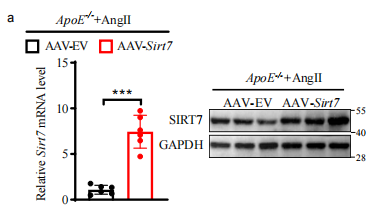
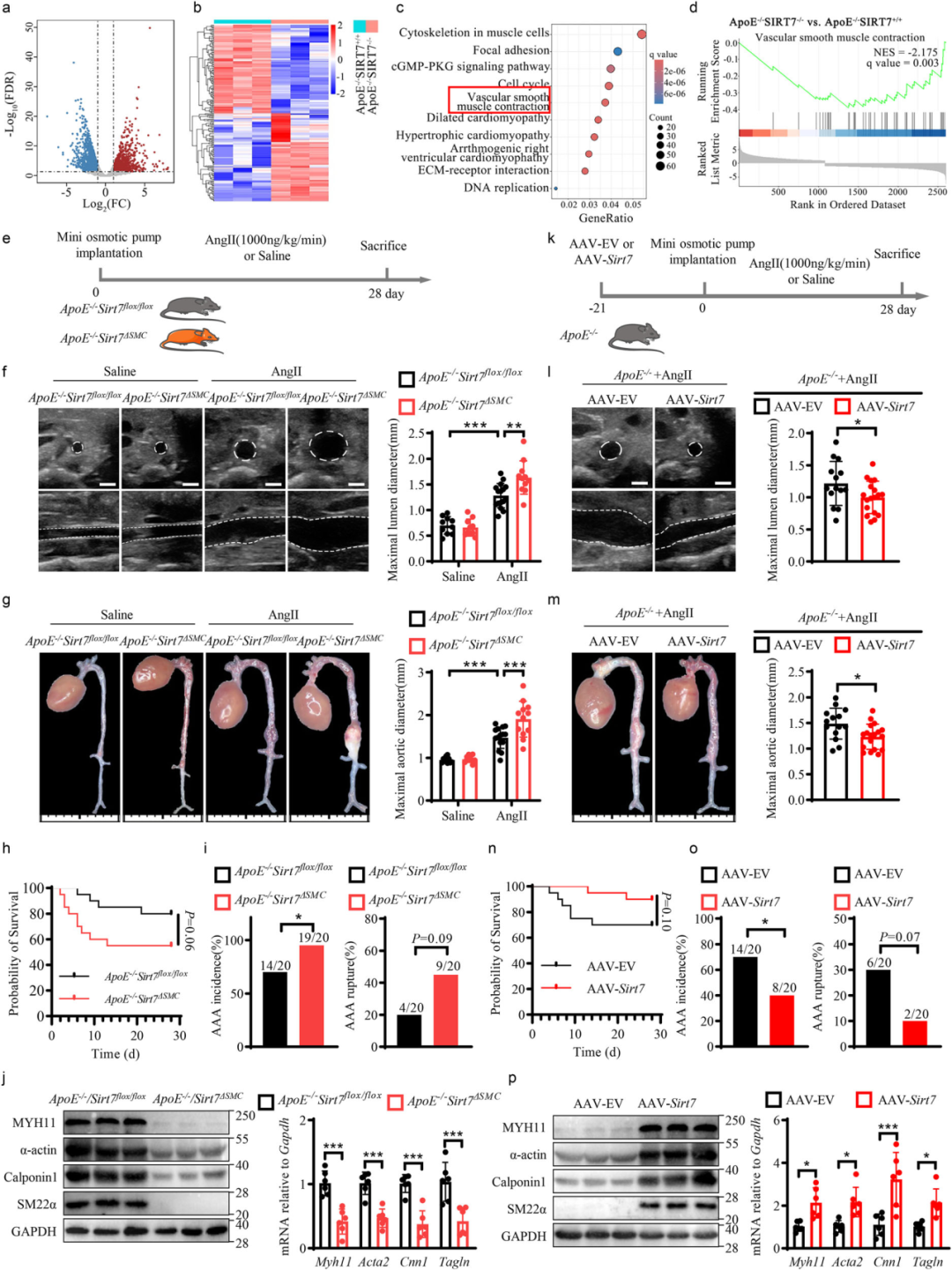
qPCR screening of the 18 HDAC subtypes identified SIRT7 as the most significantly downregulated subtype in human AAA; mRNA, protein and immunofluorescence assays all confirmed reduced SIRT7 expression in human AAA tissue; and in two independent mouse AAA models induced by AngII and CaCl2, SIRT7 was likewise significantly downregulated in aneurysmal vessels. The team generated systemic Sirt7 knockout mice. In the AngII-induced AAA model, Sirt7-/- mice showed significantly increased aortic diameter, markedly higher AAA incidence, rupture rate and mortality, and more severe elastic fibre degradation, without effects on blood pressure, body weight or lipid profile; aggravated AAA was also observed in the CaCl2 model. RNA-seq of aneurysmal tissue from systemic Sirt7 knockout mice showed that differentially expressed genes were significantly enriched in the vascular smooth muscle contraction pathway. VSMC-specific Sirt7 knockout mice were then generated and reproduced the aggravated AAA phenotype. To further verify the pathological role of SIRT7, the team used the AAV9-SM22α vector to overexpress Sirt7 in the VSMCs of ApoE-/- mice, which significantly suppressed aortic dilatation, reduced AAA incidence, rupture rate and mortality, preserved elastic fibre integrity and restored the expression of VSMC contractile markers, confirming the vascular protective function of SIRT7.
SIRT7 prevents AngII-induced AAA formation by regulating VSMC phenotype switching
2. SIRT7 directly deacetylates SRF-K154 to maintain the VSMC contractile phenotype
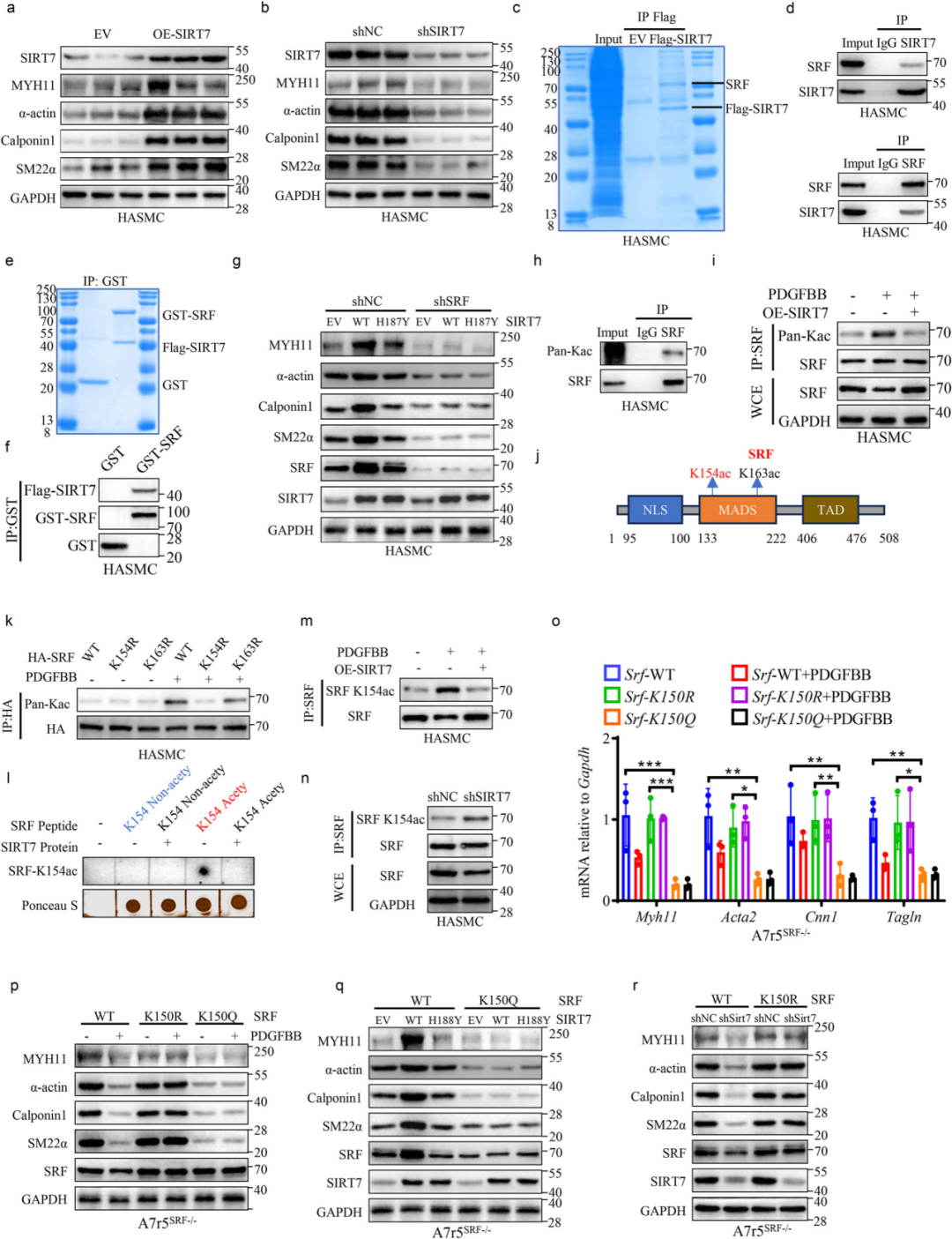
In vitro results showed that SIRT7 maintains the contractile phenotype in vascular smooth muscle cells through its deacetylase activity, and that its protective function strictly depends on this enzymatic activity. Co-IP, GST pull-down and mass spectrometry confirmed that SIRT7 interacts directly with SRF; knockdown of SRF abolished the ability of SIRT7 to maintain the VSMC contractile phenotype, demonstrating that SRF is the key downstream effector through which SIRT7 regulates this phenotype. The team detected acetylation of SRF in HASMCs, and this modification was enhanced upon PDGF-BB stimulation but could be reversed by SIRT7 overexpression; SIRT7 knockdown, in contrast, increased SRF acetylation levels. Knockdown of SIRT1/SIRT6 did not affect SRF acetylation, suggesting that this modification is SIRT7-specific. Mass spectrometry identified human SRF-K154 (the corresponding homologous site in mice being K150) as the acetylation site; in vitro deacetylation assays (using a synthetic acetylated peptide) confirmed that SIRT7 can directly remove the acetylation modification at K154. The deacetylated state of SRF-K154 (rather than the acetylated state) is the key molecular switch for maintaining the VSMC contractile phenotype. Further study showed that, by deacetylating SRF at K154, SIRT7 inhibits the ubiquitin-proteasome degradation of SRF, thereby stabilizing SRF protein levels and maintaining its transcriptional regulatory function.
SIRT7 regulates VSMC phenotype switching in vitro by deacetylating SRF
3. Overexpression of deacetylated SRF slows AAA formation
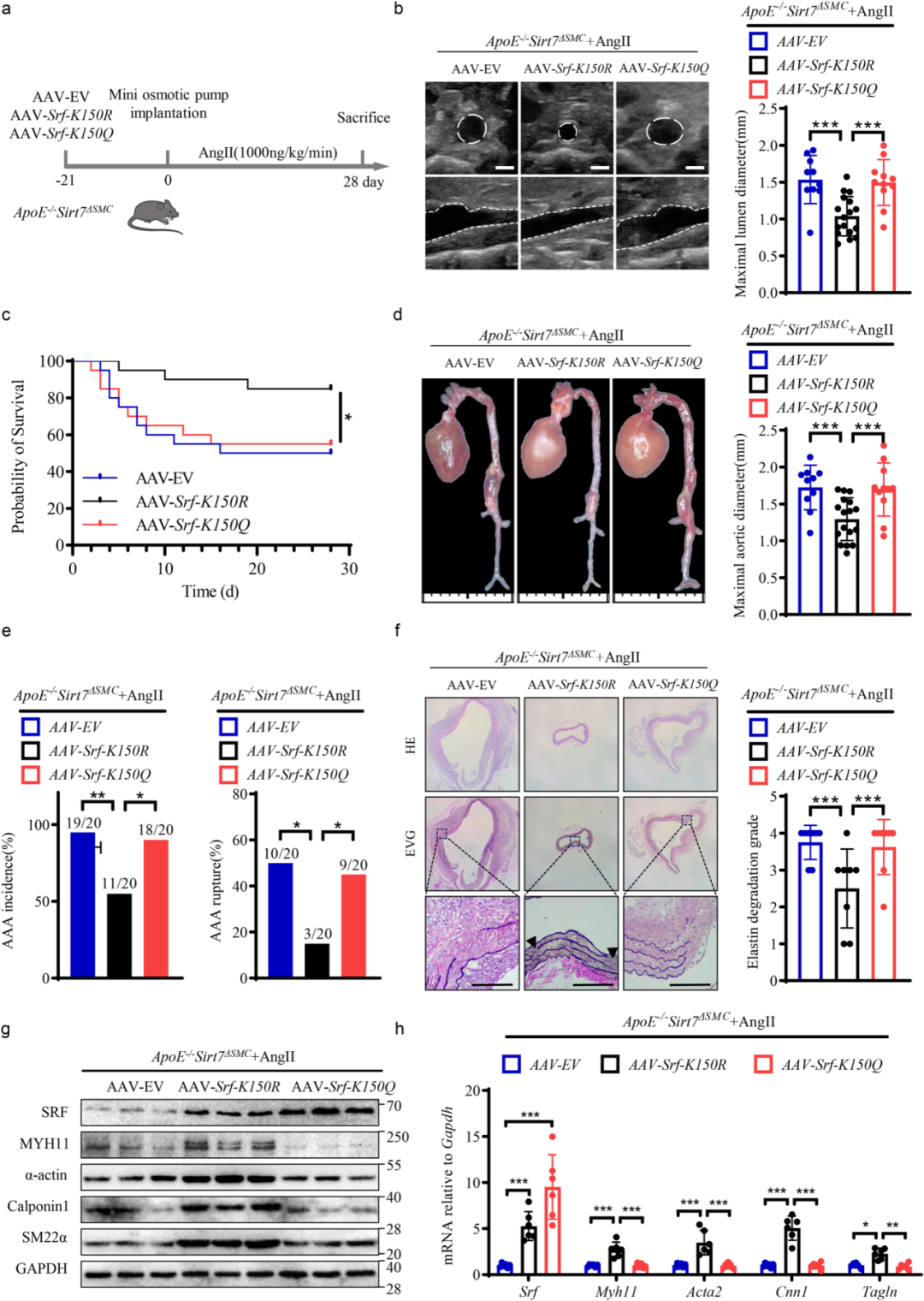
Next, the researchers determined the subcellular location of SRF degradation. The data showed that SRF ubiquitination occurs mainly in the cytoplasm and increases after PDGF-BB stimulation; SIRT7-mediated K154 deacetylation prevents SRF nuclear export, whereas K154 acetylation promotes it. SIRT7 knockdown significantly enhanced PDGF-BB-induced SRF nuclear export, while SIRT7 overexpression significantly inhibited this process. Systematic knockdown screening of the candidate nuclear export proteins XPO1/4/5/7 showed that only XPO1 knockdown blocked PDGF-BB-induced SRF nuclear export. By deacetylating K154, SIRT7 inhibits the binding of SRF to XPO1 and prevents SRF nuclear export, thereby retaining it in the nucleus to enhance its transcriptional activity. In in vivo rescue experiments, the team introduced AAV9-SM22α-empty vector (EV), Srf-K150R or Srf-K150Q separately into VSMC-specific Sirt7 knockout mice. The results showed that Srf-K150R significantly alleviated aortic dilatation, reduced AAA incidence, rupture rate and mortality, preserved elastic fibre integrity and restored the expression of VSMC contractile markers, whereas Srf-K150Q had no protective effect, demonstrating that the protective effect of SIRT7 depends on deacetylation at the SRF-K154 (K150 in mice) site. Finally, the team assessed whether pharmacological activation of SIRT7 could suppress AAA formation. Prophylactic administration of the NAD+ precursor NMN before AAA induction significantly inhibited aneurysm formation and restored the VSMC contractile phenotype in both AAA mouse models, confirming the feasibility of NMN as a therapeutic strategy for AAA.
Overexpression of deacetylated SRF-K154 alleviates aortic aneurysm
Conclusions
In summary, this study identifies SIRT7 as a potential core regulator of AAA pathogenesis. It establishes SRF as its substrate and demonstrates that SIRT7-mediated deacetylation of SRF-K154 is essential for the transcriptional activity and protein stability of SRF. These findings reveal a conserved signalling axis that regulates aortic integrity. In addition, NAD+ supplementation emerges as a plausible non-surgical therapeutic strategy. These findings advance the understanding of the biological mechanisms of AAA and highlight the SIRT7-SRF axis as a promising therapeutic target.