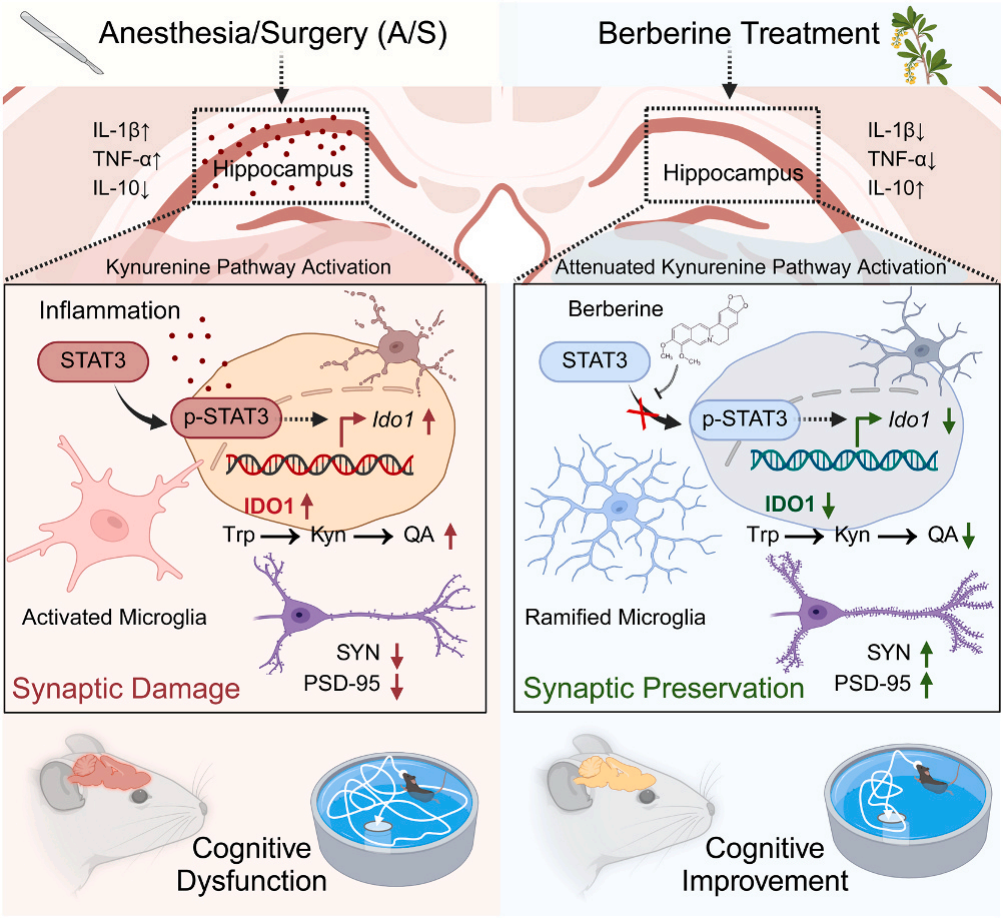
IF 12.2: Xiaochun Zheng and Yusheng Yao's Team at Fujian Provincial Hospital Reveal a New Mechanism by Which Berberine Ameliorates Postoperative Cognitive Dysfunction in Aged Mice: Targeting the Microglial STAT3–IDO1 Axis
Paper title: Berberine alleviates postoperative cognitive dysfunction by suppressing microglial IDO1 induction and kynurenine pathway activation in aged mice
Journal: Pharmacological Research (IF 12.2)
Collaborating partner: Prof. Xiaochun Zheng and Prof. Yusheng Yao's team, Fujian Provincial Hospital
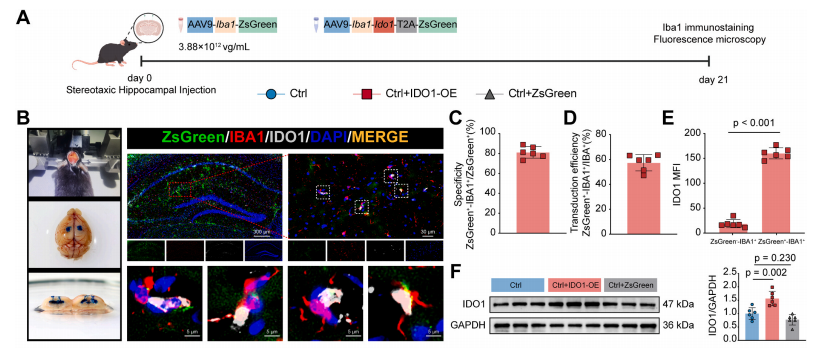
Verification of the specificity and efficiency of AAV9-Iba1-Ido1 transduction in microglia
Research Background
Postoperative cognitive dysfunction (POCD) is a common complication after surgery in elderly patients, and no pharmacological treatment has been approved to date. Although activation of the kynurenine pathway mediated by indoleamine 2,3-dioxygenase 1 (IDO1) has been associated with perioperative neurocognitive impairment, the cellular source of this pathway activation in the hippocampus and its upstream transcriptional regulatory mechanisms remain unclear. In August 2026, Prof. Xiaochun Zheng and Prof. Yusheng Yao's team at Fujian Provincial Hospital published an article entitled Berberine alleviates postoperative cognitive dysfunction by suppressing microglial IDO1 induction and kynurenine pathway activation in aged mice in Pharmacological Research (IF 12.2). The study revealed that berberine directly binds STAT3 and inhibits STAT3-dependent IDO1 transcription in microglia, thereby blocking kynurenine pathway activation and alleviating postoperative cognitive dysfunction in aged mice.
Research Findings
1. Berberine dose-dependently improves cognition and attenuates neuroinflammation
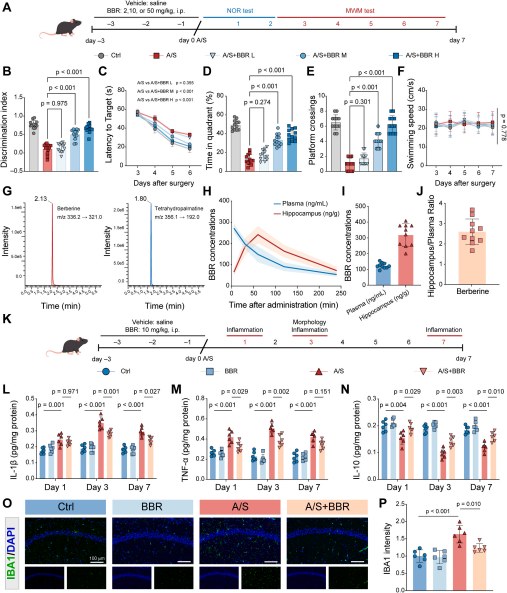
Aged mice exposed to anesthesia and tibial fracture surgery exhibited significant cognitive impairment, including a decreased novel object recognition discrimination index, prolonged Morris water maze escape latency, reduced time spent in the target quadrant and platform crossings, with no difference in swimming speed (excluding the interference of locomotor capacity). Hippocampal IDO1 protein began to rise from day 1 after surgery, peaked on day 3, and remained above control levels on day 7; kynurenine (KYN) was elevated and the KYN/TRP ratio increased, and this ratio was negatively correlated with cognitive behavioral indicators. Exogenous administration of L-kynurenine to non-surgical mice dose-dependently replicated the cognitive impairment, and pretreatment with the IDO1 inhibitor 1-MT alleviated surgery-induced cognitive deficits, kynurenine pathway activation, and microglial activation. These results indicate that IDO1-driven tryptophan-kynurenine pathway activation is a critical mediator of postoperative cognitive impairment in aged mice. Berberine was effective at 10 and 50 mg/kg but ineffective at 2 mg/kg, improving cognition and suppressing hippocampal neuroinflammation; in addition, berberine protected the dendritic architecture, synaptic ultrastructure, and synaptic proteins of hippocampal CA1 neurons in aged surgical mice, counteracting the structural damage caused by anesthesia and surgery.
Berberine dose-dependently improves cognition in aged mice and attenuates neuroinflammation after anesthesia/surgery
2. Microglial Ido1 overexpression attenuates the protective effect of berberine
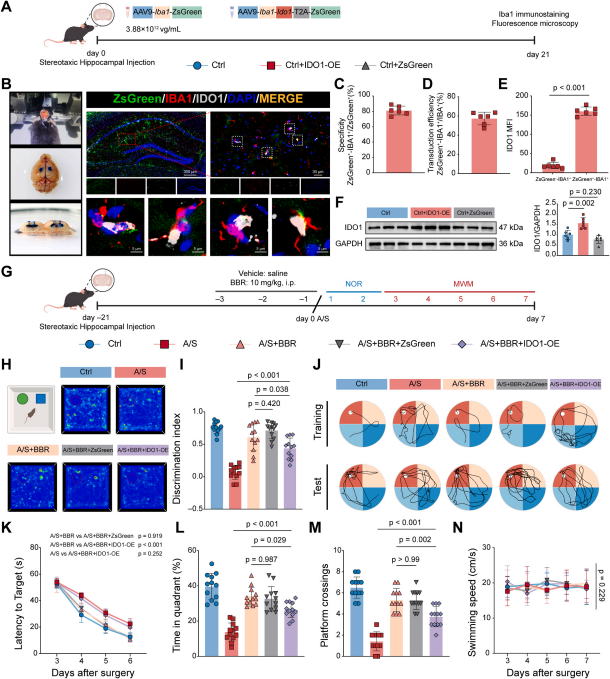
The research team found that berberine attenuated anesthesia/surgery-induced hippocampal IDO1 elevation and reduced L-kynurenine and the KYN/TRP ratio; multiplex immunofluorescence and double labeling showed that surgery mainly induced IDO1 upregulation in microglia, and berberine significantly inhibited the microglial IDO1 increase. In vitro co-culture suggested that the neuroprotection of berberine mainly depends on microglia. The team further overexpressed Ido1 preferentially in microglia by bilateral hippocampal injection of AAV9-Iba1-Ido1-T2A-ZsGreen. Compared with the A/S+BBR group, the Ido1 overexpression group showed a decreased novel object recognition discrimination index, prolonged Morris water maze escape latency, and reduced time spent in the target quadrant and platform crossings; the empty-vector control group showed none of these changes. In an independent cohort assessed on postoperative day 3, microglial Ido1 overexpression partially reversed the effects of berberine: hippocampal IDO1 protein and IBA1 microglial activation fluorescence intensity rebounded; L-kynurenine and the KYN/TRP ratio rose again but remained lower than those of the surgery-only group; no significant difference was observed between groups for L-tryptophan. In addition, Ido1 overexpression returned most dendritic and synaptic protection indicators to A/S levels, but dendritic spine density retained partial protection.
Microglia-targeted IDO1 overexpression attenuates the cognitive benefits of berberine
3. Berberine binds STAT3 and inhibits STAT3-dependent Ido1 promoter activity
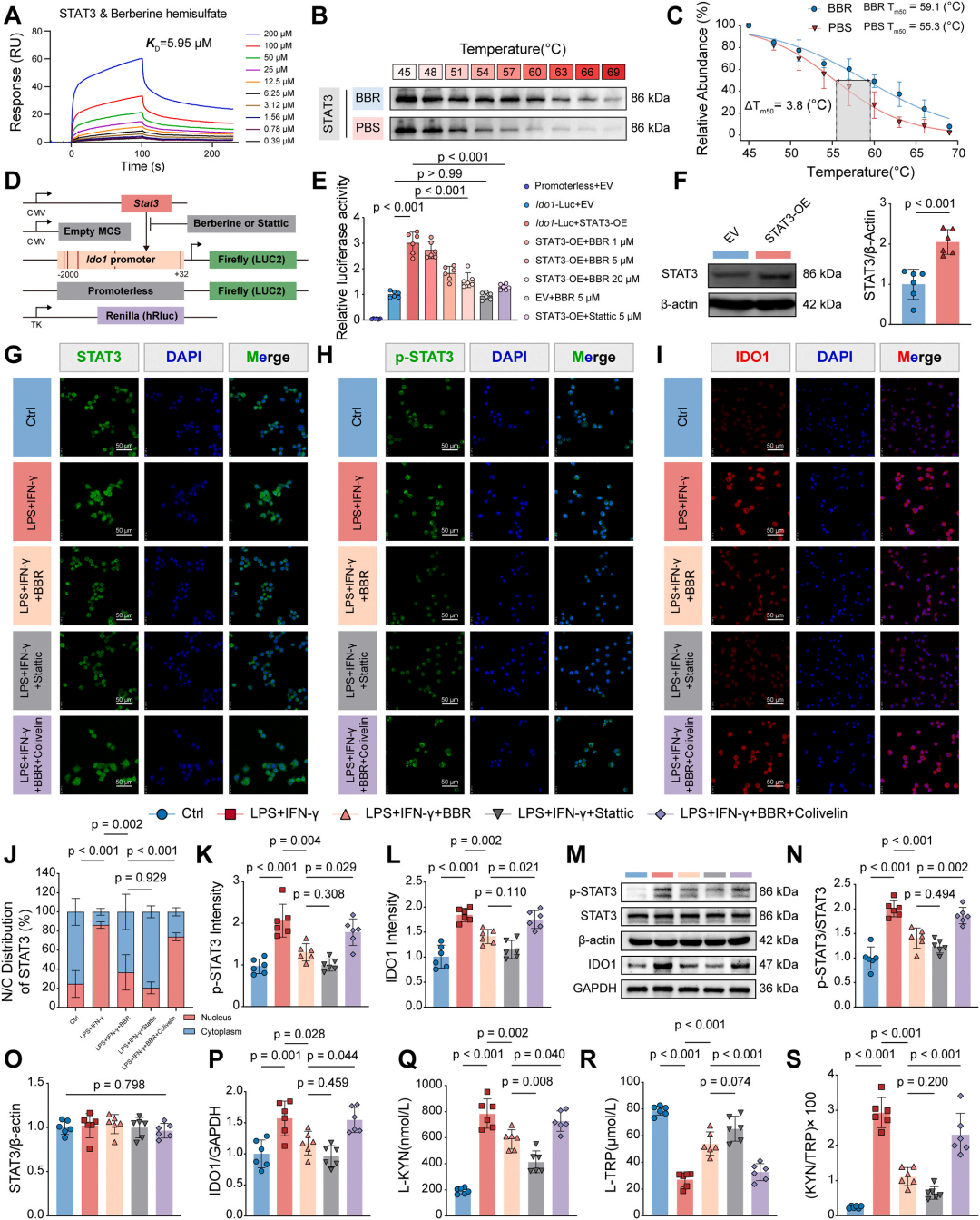
Finally, the research team explored the mechanism by which berberine inhibits IDO1 in microglia. Network pharmacological analysis identified common targets of berberine and POCD, and STAT3 was a top-ranked hub molecule; molecular docking and molecular dynamics simulations suggested that berberine can bind STAT3 to form a stable complex. Surface plasmon resonance confirmed that berberine directly binds recombinant mouse STAT3, and the cellular thermal shift assay showed that berberine treatment elevated the apparent melting temperature of STAT3 by 3.8 ℃. Dual-luciferase IDO1 promoter reporter assays showed that STAT3 overexpression significantly activated Ido1 promoter transcriptional activity; berberine concentration-dependently inhibited STAT3-mediated Ido1 promoter activation; the STAT3 inhibitor Stattic reproduced this inhibitory effect; and in the absence of STAT3 overexpression, berberine had almost no effect on the Ido1 promoter, indicating that berberine's inhibition of Ido1 transcription depends on STAT3. Functional validation in BV2 microglia further confirmed that berberine directly binds STAT3, inhibits STAT3 phosphorylation and nuclear translocation, and thereby suppresses STAT3-driven Ido1 transcription.
Berberine binds STAT3 and inhibits STAT3-dependent Ido1 promoter activity
Conclusions
In aged mice, berberine ameliorates postoperative cognitive dysfunction by suppressing IDO1 induction in hippocampal microglia and limiting kynurenine pathway activation, thereby alleviating dendritic and synaptic damage. Berberine acts on STAT3 in microglia and inhibits STAT3-dependent Ido1 promoter activity, while microglia-targeted Ido1 overexpression can attenuate the protective effect of berberine. These findings suggest that the microglial STAT3-IDO1 axis is a potential target for perioperative neuroprotection, and defining the therapeutic time window of the drug is the next research priority for advancing its clinical translation.