Nat Neurosci | Bailong Xiao's Team at Tsinghua University Establishes a New Behavioral Genomics Screening System and Identifies Key Genes Regulating Somatosensory Multimodality
Custom AAV | AAV9 In Vivo CRISPR Screening | Creld1 Regulates Somatosensation - WZBIO
Paper title: Behavioral genomics identifies Creld1 as a cross-modal regulator of somatosensation
Journal: Nature Neuroscience (IF 20.3)
Collaborating partner: Bailong Xiao's team, School of Pharmaceutical Sciences, Tsinghua University
· WZBIO Product Contribution ·
Animal model
P0-P2 mice
Viral product
Custom AAV: AAV9-sgRNAs-eGFP (targeting Trpv1, Piezo2, Scn9a and more than 20 other genes of interest); AAV9-hSYN-GFP; AAV9-hSYN-mCreld1; AAV9-hSYN-Creld1-ΔTM
Injection route
Stereotactic injection into the ventricle
Injection volume
1.5 μl
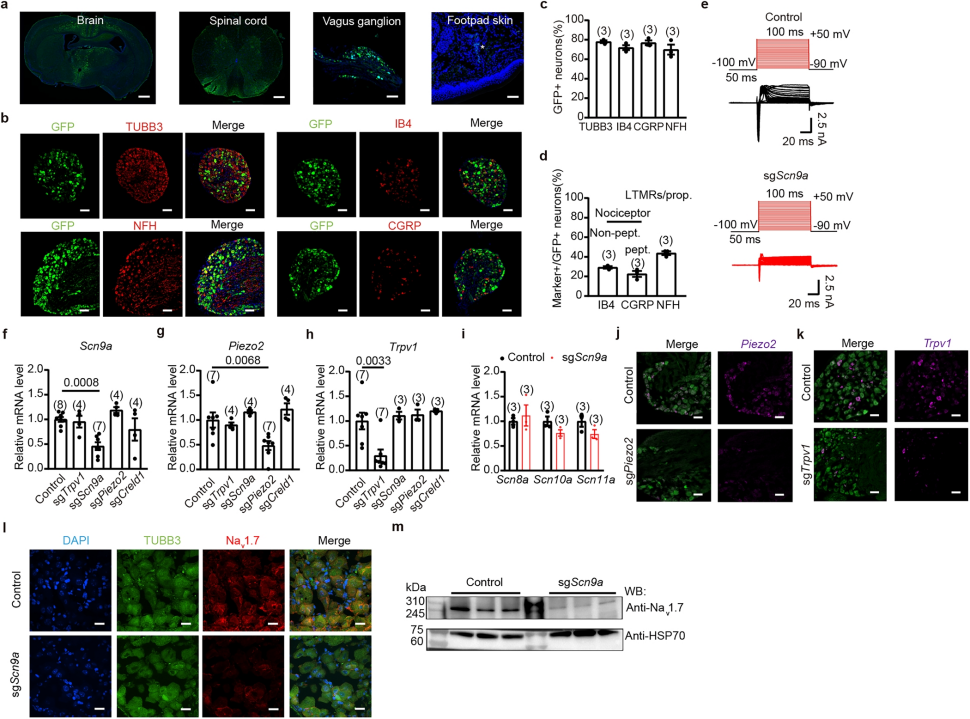
Identification of AAV9-mediated sgRNA delivery and knockout of DRG-expressed genes
Research Background
Somatosensation is mediated by dorsal root ganglion (DRG) neurons, which convert physical and chemical stimuli into electrical signals. However, the full molecular complement underlying somatosensation has not yet been completely elucidated. The research team developed an in vivo screening platform based on AAV9-mediated sgRNA delivery that achieves CRISPR-Cas9 gene knockout in DRG of postnatal early (P0–P2) mice, and identified Creld1 as a cross-modal master regulator of somatosensation, which acts as an auxiliary regulator of voltage-gated sodium channels (Nav), enhancing Nav currents and modulating DRG neuronal excitability.
Research Findings
1. Targeted genomic screening identifies Creld1 as a pan-sensory regulator
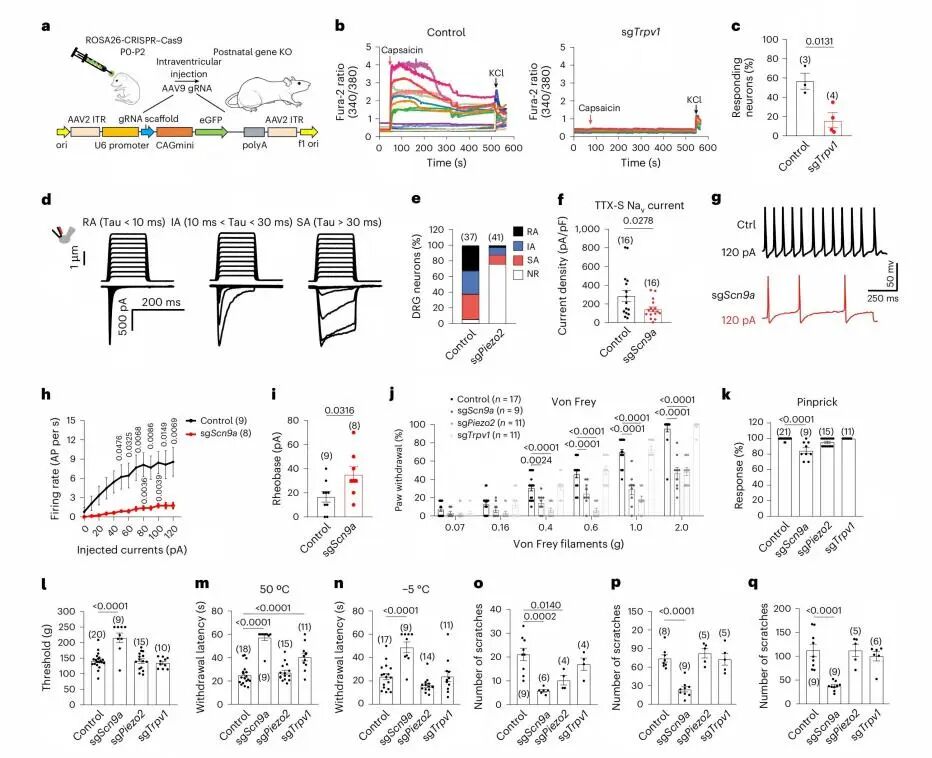
The research team established a CRISPR-Cas9-based gene knockout platform for DRG in neonatal mice. Intraventricular injection of AAV9 viruses carrying sgRNAs into P0-P2 Cas9 mice efficiently and without preference transduced all classes of DRG sensory neurons. Three classic sensory genes, Trpv1, Piezo2, and Scn9a, were selected for validation; qPCR, in situ hybridization, and protein assays confirmed significant downregulation of the target genes with almost no off-target effects. Electrophysiology and calcium imaging reproduced the corresponding cellular functional deficits of each gene, and animal behavioral assays also recapitulated the known sensory phenotypes, demonstrating that this platform can circumvent the embryonic lethality and developmental compensation associated with traditional knockout and is suitable for studying sensory gene function in adult mice.
Using this platform, a targeted behavioral genomic screen of 20 candidate genes was conducted, and Creld1 was identified as a key regulator of somatosensation. Creld1 sgRNA knockout mice showed broad impairments in touch, mechanical pain, hot and cold pain, inflammatory pain hypersensitivity, and itch, while motor ability and body weight were normal, excluding interference from general health deficits. Single-cell sequencing and immunostaining showed that Creld1 is broadly expressed across all classes of DRG neurons. To exclude potential interference from the viral system, the researchers generated tamoxifen-inducible DRG-specific conditional knockout mice. Constitutive whole-body knockout of Creld1 causes embryonic death, whereas adult inducible knockout successfully circumvented the lethal phenotype. The conditional knockout mice perfectly recapitulated all multimodal sensory deficits of the viral knockout mice, with no obvious abnormalities in DRG neuronal subtypes or neural projections. The two independent models mutually corroborate that CRELD1 regulates multiple somatosensory modalities specifically in DRG neurons.
Postnatal knockout of DRG-expressed genes
2. CRELD1 interacts with and modulates voltage-gated sodium channels in mouse DRG neurons
The team first confirmed that CRELD1 does not directly regulate the various sensory receptors. In DRG neurons of Creld1 knockout mice, calcium signals evoked by heat, cold, capsaicin, histamine, chloroquine and other stimuli, as well as Piezo-mediated mechanically activated currents, showed no abnormalities. This means that CRELD1 does not act on upstream transduction receptors responsible for specific stimulus detection, such as TRPV1 and Piezo2, but functions downstream of the receptors.
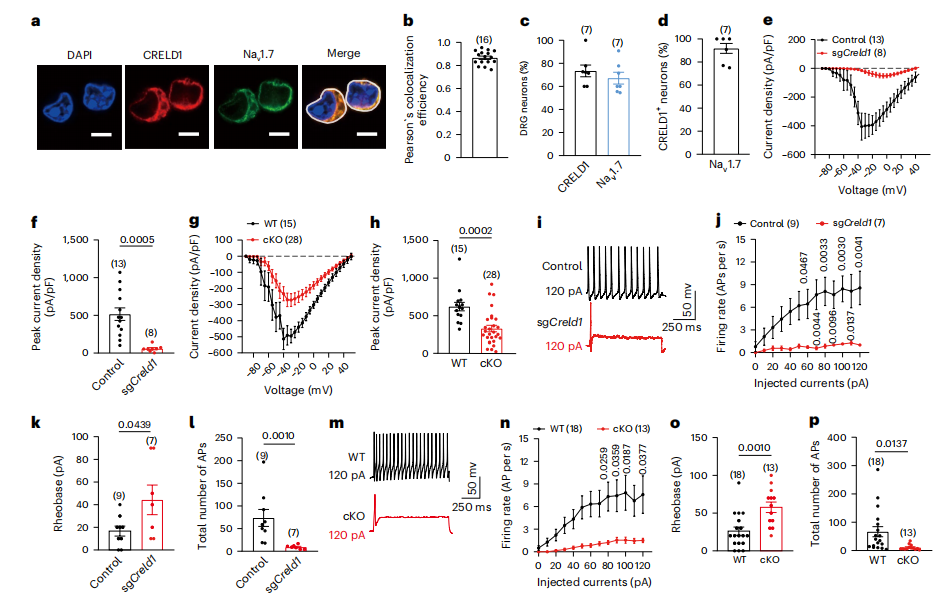
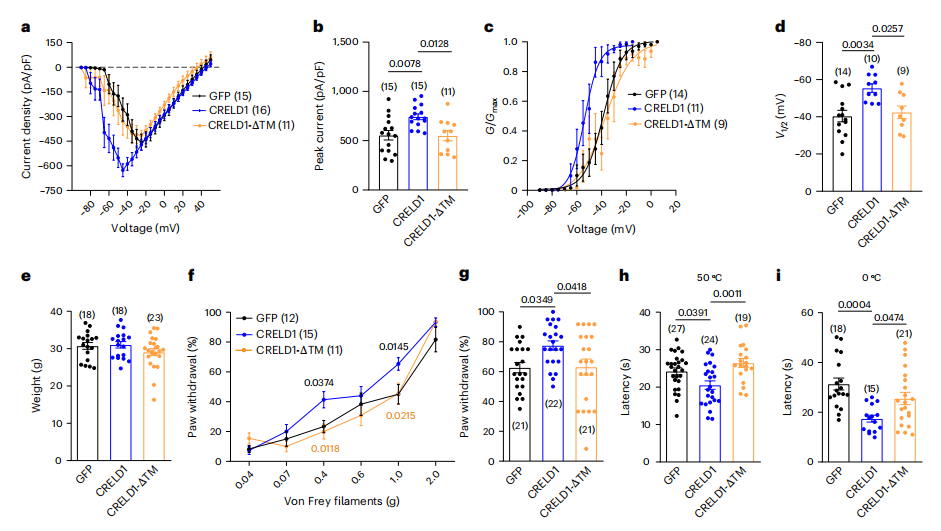
Subsequent interaction screening confirmed that CRELD1 can bind multiple voltage-gated sodium channels, including Nav1.7. Knockout of Creld1 significantly reduced sodium current density and action potential firing in DRG neurons, decreasing neuronal excitability; however, the transcript levels and total protein expression of Nav subtypes were unchanged, suggesting a post-translational functional regulation. Structure-function experiments further revealed its mode of action: CRELD1 relies on its C-terminal transmembrane domain for binding to and functional modulation of Nav. In heterologous expression systems, full-length CRELD1 increased sodium currents and shifted the channel activation curve toward hyperpolarization, whereas a truncation mutant lacking the transmembrane region lost this regulatory capacity. Meanwhile, cell-surface biotinylation assays demonstrated that CRELD1 does not alter the expression level of Nav on the cell membrane; rather than regulating channel membrane trafficking, it directly modulates the gating properties of sodium channels on the membrane, thereby regulating neuronal excitability.
CRELD1 regulates Nav and excitability of DRG neurons
3. Overexpression of CRELD1 in DRG neurons enhances somatosensory behaviors
The study found that human CRELD1 has multiple splice isoforms whose ability to regulate Nav1.7 depends on the variable C-terminal transmembrane domain. Isoforms retaining this conserved transmembrane segment can bind and enhance Nav1.7 channel activity, functioning similarly to mouse CRELD1; whereas subtypes with altered C-terminal transmembrane sequences lose the ability to bind and regulate Nav1.7. This result also explains a clinical observation: patients with CRELD1 mutations often present cardiac and neurodevelopmental abnormalities but mostly lack somatosensory deficits, likely related to the functional divergence of different isoforms in vivo.
To further verify causality, the team used AAV to overexpress full-length CRELD1 and a transmembrane-deleted mutant in DRG neurons of neonatal mice, respectively. Electrophysiological results showed that full-length CRELD1 overexpression increased sodium current amplitude, shifted the channel activation curve toward hyperpolarization, and upregulated neuronal excitability, whereas the truncation mutant had no regulatory effect. Behavioral assays also confirmed that mice overexpressing full-length CRELD1 showed significantly enhanced sensitivity to touch and hot/cold sensations, while the mutant group showed no difference from controls. The gain- and loss-of-function experiments corroborate each other, indicating that CRELD1 is both necessary and sufficient for regulating DRG somatosensory responses.
In this study, AAV9-delivered single guide RNAs were used to construct an efficient postnatal CRISPR–Cas9 knockout platform for dissecting the functions of genes expressed in mouse dorsal root ganglia, and targeted screening identified Creld1 as a cross-modal regulator of somatosensation. Mechanistically, CRELD1 acts as an auxiliary regulator of voltage-gated sodium channels (Nav), modulating the excitability of DRG neurons. In summary, this study established a stable and reliable postnatal behavioral genomics screening platform and demonstrated that Creld1 is a core regulator of somatosensory function.
The AAV service in this study was provided by WZBIO.
Contact Us
Have a question or need assistance? Our team is here to help. Fill out the form below, and we willrespond within 1-2 business days.