New Breakthrough in Osteoporosis Research! Tongji Hospital, Tongji Medical College, Huazhong University of Science and Technology Team Reveals How Handelin Inhibits Osteoclastogenesis
Adenoviral Vector Construction Powers Handelin Research | Tongji Hospital, Huazhong University of Science and Technology Team in Phytomedicine (IF 11.3) Reveals That Handelin Targets the LCN2-Autophagy Pathway to Inhibit Osteoclastogenesis
Paper title: Handelin inhibits osteoclastogenesis and bone loss by targeting lipocalin-2 and restoring autophagy to suppress NF-κB signaling
Journal: Phytomedicine (IF 11.3)
Collaborating partner: Tongji Hospital, Tongji Medical College, Huazhong University of Science and Technology, Zhu Meipeng, Kang Honglei and Hu Peixuan
Excessive osteoclastogenesis is a key pathological process in osteoporosis, and identifying compounds that effectively suppress osteoclastogenesis without toxicity is of major therapeutic importance. Handelin is a guaianolide dimer derived from chrysanthemum and other plants of the genus Chrysanthemum, with known anti-inflammatory and antioxidant properties, but its role in osteoclastogenesis remained unclear. In this study, the authors identified Handelin as a novel inhibitor of osteoclastogenesis that targets the LCN2-autophagy pathway and suppresses NF-κB signalling, demonstrating its potential as a therapeutic agent for osteoporosis and related bone diseases. The findings were published in Phytomedicine (IF 11.3).
Research Results
1. Handelin promotes autophagic flux and disrupts the p62-TRAF6 interaction in an LCN2-dependent manner
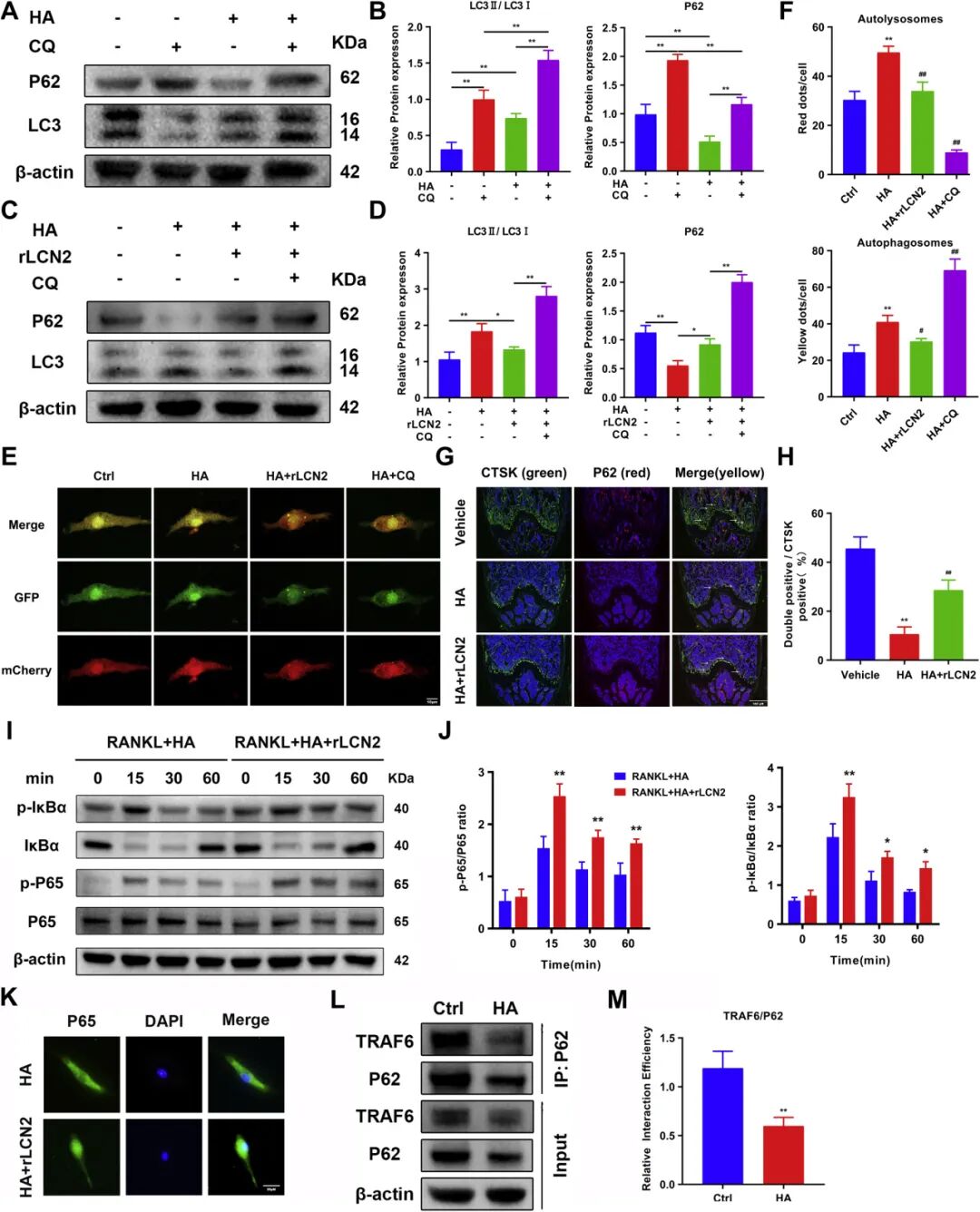
The authors found that Handelin inhibited osteoclast differentiation and function in vitro and ameliorated OVX (ovariectomy)-induced bone loss in vivo; mechanistic studies showed that LCN2, autophagy and the NF-κB pathway are key targets of Handelin, and that Handelin can bind directly to LCN2 and suppress its expression. Western blot analysis showed that Handelin increased LC3-II levels and reduced p62 accumulation, indicating enhanced autophagic activity, and an LC3 turnover assay also demonstrated that Handelin promotes autophagic flux. The authors used rLCN2 (recombinant lipocalin-2) to investigate the role of LCN2, and found that rLCN2 attenuated the effects of Handelin and reduced Handelin-induced LC3-II accumulation. A tandem fluorescent LC3 assay confirmed that autolysosome formation increased after Handelin treatment, whereas rLCN2 reduced autolysosome formation. In vivo, rLCN2 likewise reversed Handelin-induced p62 downregulation. Given the role of p62 in NF-κB signalling, the authors examined pathway activation and found that rLCN2 partially restored the NF-κB activity suppressed by Handelin; co-immunoprecipitation assays further demonstrated that Handelin reduced the interaction between p62 and TRAF6, indicating that Handelin enhances autophagic flux and disrupts the p62-TRAF6 complex in an LCN2-dependent manner, thereby suppressing NF-κB signalling.
Figure 1. Effects of rLCN2 on autophagy, NF-κB signalling and the p62-TRAF6 interaction in BMMs
2. p62 overexpression restores the NF-κB signalling and osteoclastogenesis suppressed by Handelin
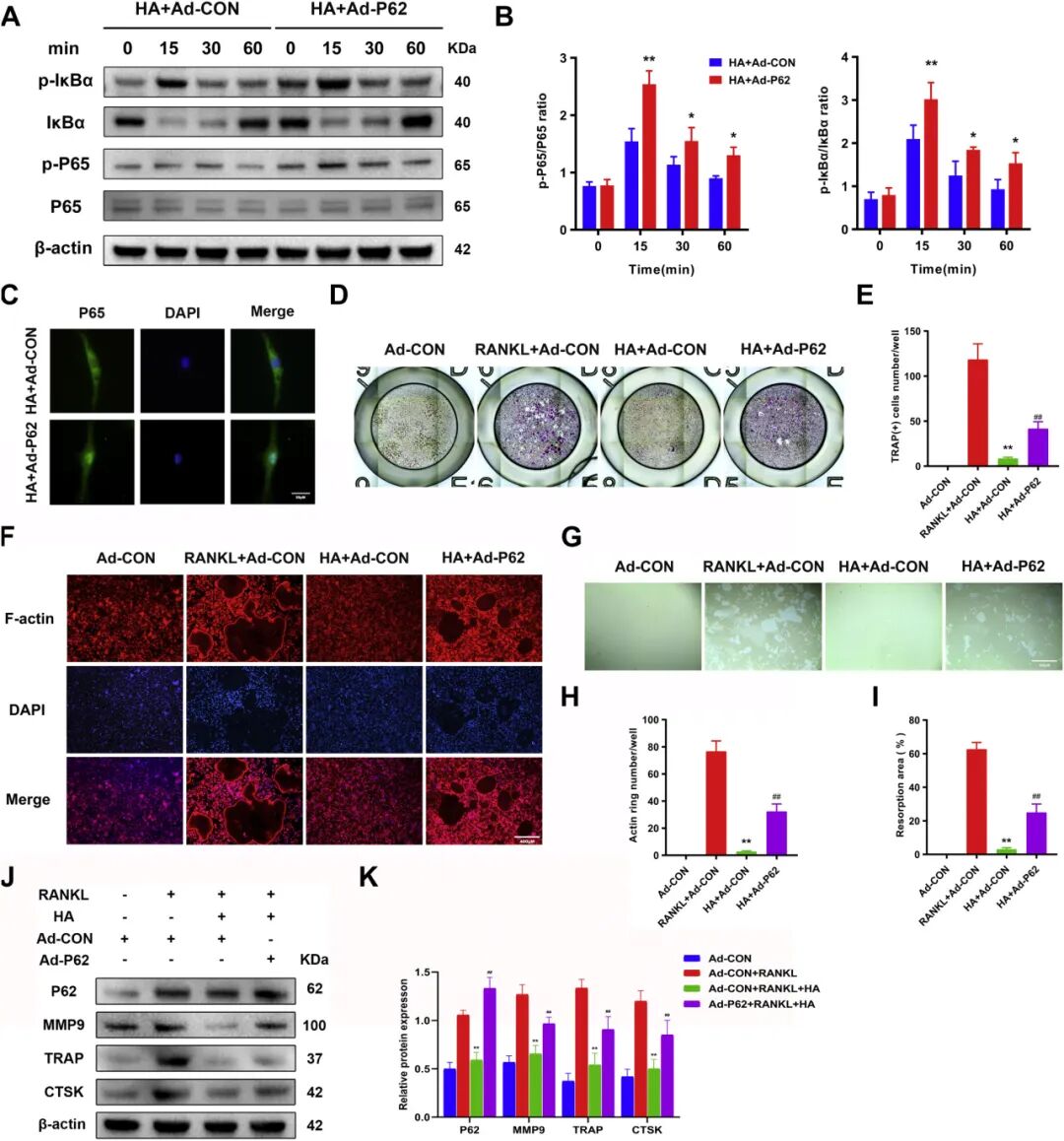
To further investigate the role of p62, the authors transduced BMMs with adenovirus overexpressing p62. Western blot analysis showed that p62 overexpression restored the NF-κB signalling suppressed by Handelin, and immunofluorescence analysis confirmed enhanced nuclear translocation of p65. In addition, p62 overexpression attenuated the inhibitory effect of Handelin on osteoclast differentiation and activity, with osteoclast formation and function partially restored, indicating that p62 is a key mediator of Handelin-induced suppression of the TRAF6-NF-κB pathway and osteoclastogenesis. The authors used rLCN2 to further verify the key role of LCN2 in vivo; micro-CT, histomorphometric analysis and ELISA showed that co-administration of rLCN2 with Handelin significantly reduced its protective effects, again demonstrating that LCN2 is a key target through which Handelin exerts its anti-osteoporotic effects.
Figure 2. Effects of p62 overexpression on NF-κB signalling and osteoclastogenesis
Conclusions
This study establishes the natural compound Handelin as a specific inhibitor of osteoclastogenesis that alleviates bone loss by directly targeting LCN2; this interaction restores autophagic flux, disrupts the p62-TRAF6 complex and suppresses NF-κB signalling. These findings indicate that Handelin is a novel anti-osteoporotic agent and define LCN2 as a key regulator of osteoclast autophagy and inflammation, validating the role of LCN2 as a direct small-molecule target and thereby paving the way for new therapeutic strategies.