J Adv Res. | Academician Shusen Zheng's Team Reveals a Precision Therapeutic Strategy Targeting Replication Stress in Hepatocellular Carcinoma
Lentiviral Packaging | Human gRNA Lentiviral Library | WEE1 Synthetic Lethality in Liver Cancer - WZBIO
Paper title: Comprehensive multi-omics analyses exposes a precision therapy strategy that targets replication stress in hepatocellular carcinoma using WEE1 inhibition
Journal: Journal of Advanced Research (IF 11.4)
Collaborating partners: Academician Shusen Zheng and Professor Penghong Song's team, the First Affiliated Hospital, Zhejiang University School of Medicine
· WZBIO Support - Lentiviral CRISPR Knockout Library ·
Hepatocellular carcinoma (HCC) is a highly heterogeneous malignancy with a poor prognosis, and standard treatment strategies are effective only in patients with a limited number of subtypes. More effective vulnerability-targeted or individualized therapeutic strategies for advanced HCC are therefore urgently needed. On February 18, 2025, the team of Academician Shusen Zheng and Professor Penghong Song at the First Affiliated Hospital, Zhejiang University School of Medicine published the paper “Comprehensive multi-omics analyses exposes a precision therapy strategy that targets replication stress in hepatocellular carcinoma using WEE1 inhibition” in the Journal of Advanced Research (IF 11.4), reporting that tumor replication stress (RS) levels can serve as a prognostic indicator for HCC and guide risk-benefit-based treatment regimens, offering valuable insights for precision therapy.
Research Findings
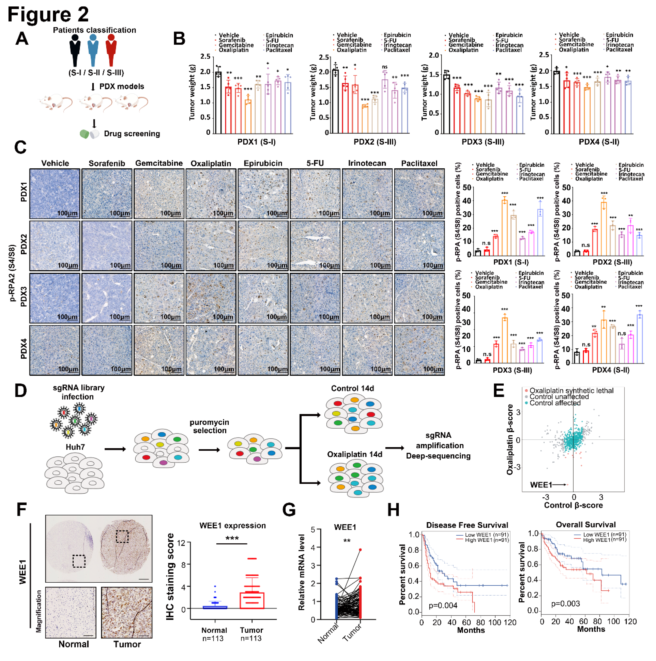
1. Library screening identifies WEE1 as a synthetic lethal gene of oxaliplatin in HCC
The authors performed proteomic and transcriptomic sequencing of 178 and 94 untreated primary HCC clinical samples, respectively, and found that the hyperproliferation subtype showed the worst prognosis and the highest RS levels, indicating that RS is a distinctive feature of HCC and a highly promising therapeutic target; drug screening further identified oxaliplatin as an RS-targeted therapy for HCC. Kinases are attractive drug targets, so the authors used a kinome-targeted lentiviral CRISPR knockout library to systematically identify targets that sensitize HCC cells to oxaliplatin, and found that WEE1 was the most significant synthetic lethal gene in Huh7 cells after oxaliplatin treatment. Western blots and IHC staining showed higher WEE1 expression in HCC tumors than in adjacent non-tumor tissues, and the TCGA database showed that higher WEE1 or CDK1 expression was associated with worse survival outcomes. In addition, the HCC subgroup with the highest RS, S-III, had the highest WEE1 and CDK1 mRNA expression compared with the other two subgroups. These results suggest that targeting WEE1 may be a promising approach to counteracting RS in HCC.
Figure 1. WEE1 is a synthetic lethal gene of oxaliplatin in HCC
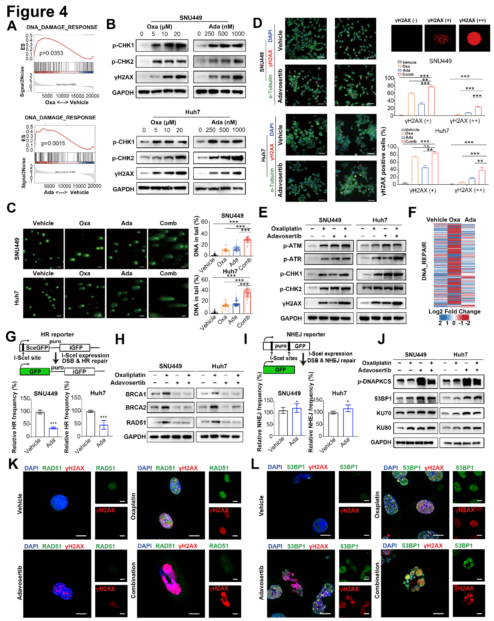
2. Adavosertib inhibits homologous recombination and enhances oxaliplatin-induced DNA damage in HCC cells
The WEE1 inhibitor adavosertib is currently in multiple phase II clinical trials, and the authors found that oxaliplatin and adavosertib synergistically suppress malignant phenotypes of HCC in vitro and in vivo. GSEA showed marked enrichment of DDR-related genes after adavosertib or oxaliplatin treatment, a result further verified by the comet tail assay. More importantly, compared with monotherapy, the combination significantly increased comet tails, γH2AX foci and the expression of DNA damage-related proteins, confirming that the synergistic combination of adavosertib and oxaliplatin leads to increased double-strand breaks and replication fork collapse in HCC cells. RNA-seq data showed that most DNA damage repair-related genes were activated after oxaliplatin treatment but suppressed after adavosertib treatment. The authors further explored the mechanism by which adavosertib enhances DNA damage and found that adavosertib reduced the efficiency of HR-mediated DNA double-strand break repair in SNU449 and Huh7 cells, while combined treatment with oxaliplatin and adavosertib caused premature mitosis and synergistically enhanced apoptosis in HCC cells.
Figure 2. Adavosertib inhibits homologous recombination and enhances oxaliplatin-induced DNA damage in HCC cells
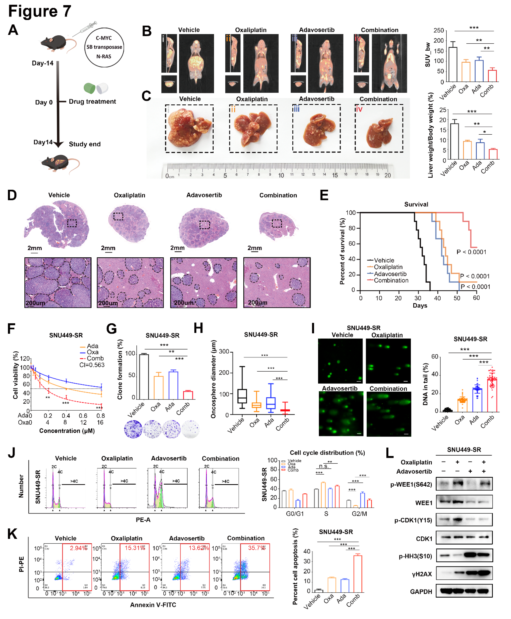
3. Oxaliplatin and adavosertib remain synergistic in the hydrodynamic injection model and in sorafenib-resistant cells
To investigate whether oxaliplatin and adavosertib act synergistically in high-RS cancers, the authors established a hydrodynamic injection (HDI) model and activated RS using oncogenic plasmids and Sleeping Beauty (SB) transposon plasmids. In HDI mice treated with monotherapy, combination therapy or vehicle, the standardized liver uptake value (SUV) in the combination group was markedly lower than in the monotherapy and control groups, and combination treatment was accompanied by reductions in the number of tumor foci and in the liver/body weight ratio. Survival analysis showed that mice in the combination group survived significantly longer than those in the control and monotherapy groups. Sorafenib is the first-line treatment for advanced HCC, but clinical resistance remains a problem. The authors examined the effect of combined oxaliplatin and adavosertib treatment on the growth of sorafenib-resistant HCC cells (SNU449-SR) and found that the combination significantly reduced colony formation and tumorsphere formation in SNU449-SR cells, caused greater accumulation of DNA damage and ultimately synergistically induced apoptosis. These results indicate that oxaliplatin combined with adavosertib retains strong synergy in high-RS models and in sorafenib-resistant models.
Figure 3. Antitumor synergy of oxaliplatin and adavosertib
Conclusions
This study provides promising insights into the precise therapeutic targeting of RS in HCC at the proteomic and transcriptomic levels, and identifies adavosertib and oxaliplatin as potentially effective treatments for hepatocellular carcinoma. The combination of adavosertib and oxaliplatin exerts an effective antitumor effect in HCC by targeting RS, enhancing DNA damage and inducing mitotic catastrophe and apoptosis. These findings indicate that tumor RS levels can serve as a prognostic indicator for HCC and guide risk-benefit-based treatment regimens, offering valuable insights for precision therapy.