IF 13.7 | The Teams of Dehua Wu, Yuan Fang and Yizhi Zhan Reveal How Spermine Metabolism Regulates Macrophage Polarization and Thereby Mediates Immune Evasion in Hepatocellular Carcinoma
Lentiviral Packaging | shRNA Lentivirus Knockdown of SMS | Macrophage M2 Polarization in Liver Cancer - WZBIO
Paper title: Spermine synthase engages in macrophages M2 polarization to sabotage antitumor immunity in hepatocellular carcinoma
Journal: Cell Death & Differentiation (IF 13.7)
Collaborating partners: The teams of Dehua Wu, Yuan Fang and Yizhi Zhan, Nanfang Hospital, Southern Medical University
Hepatocellular carcinoma (HCC) is a highly malignant tumor, and because of the immunosuppressive tumor microenvironment (TME), the efficacy of immunotherapy for HCC remains limited. Dysregulated metabolism in tumor cells reshapes the TME and impairs antitumor immunity, but the underlying mechanisms are not fully understood. The teams of Dehua Wu, Yuan Fang and Yizhi Zhan at Nanfang Hospital, Southern Medical University, published the paper “Spermine synthase engages in macrophages M2 polarization to sabotage antitumor immunity in hepatocellular carcinoma” in Cell Death & Differentiation (IF 13.7). The study found that spermine reprograms TAMs by activating the PI3K-Akt-mTOR-S6K signaling pathway, and that spermine inhibition combined with immune checkpoint blockade effectively reduces tumor burden in vivo.
Research Findings
1. SMS contributes to an immunosuppressive TME in HCC
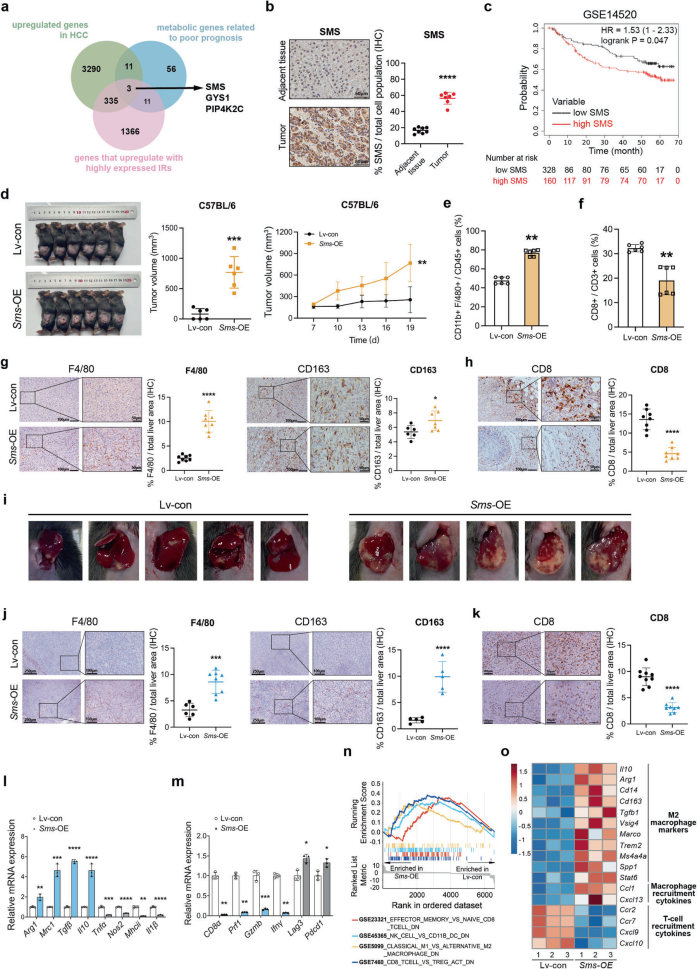
The authors first investigated key metabolic genes associated with immunosuppression in HCC and, using database screening, identified SMS as a significant metabolic gene associated with the prognosis of HCC patients, positively correlated with various T cell exhaustion signatures. In tissue samples from HCC patients, SMS levels in tumors were far higher than in adjacent tissues, and data from the GEO database (GSE14520) showed that HCC patients with higher SMS levels had a poor prognosis. These findings suggest that SMS may play a key role in the development of HCC. To further explore how SMS functions in HCC and remodels the immune environment, the authors overexpressed SMS in different HCC cell lines, but neither in vitro experiments nor tumor xenografts in nude mice showed that SMS promoted tumor cell proliferation. However, when mouse Hepa 1-6 cells were implanted subcutaneously in immunocompetent C57BL/6 mice, SMS overexpression significantly promoted tumor development, indicating that SMS may be involved in regulating the TME. Further analysis showed that elevated SMS significantly increased the proportion of macrophages in mice, especially the M2 phenotype, while reducing the proportion of CD8+ T cells. The authors then established orthotopic liver tumors using SMS-overexpressing or SMS-knockout cells to better mimic the liver microenvironment. In addition to reproducing the results obtained with subcutaneous tumors, they found that M1 macrophages and tumor-effector CD8+ T cells were reduced in the SMS overexpression group, whereas SMS knockout produced exactly the opposite results. These findings indicate that SMS may shape an immunosuppressive TME in HCC mainly by regulating macrophages and CD8+ T cells.
Figure 1. SMS promotes HCC progression in an immune microenvironment-dependent manner
2. Spermine acts as the executor of SMS-driven macrophage M2 polarization
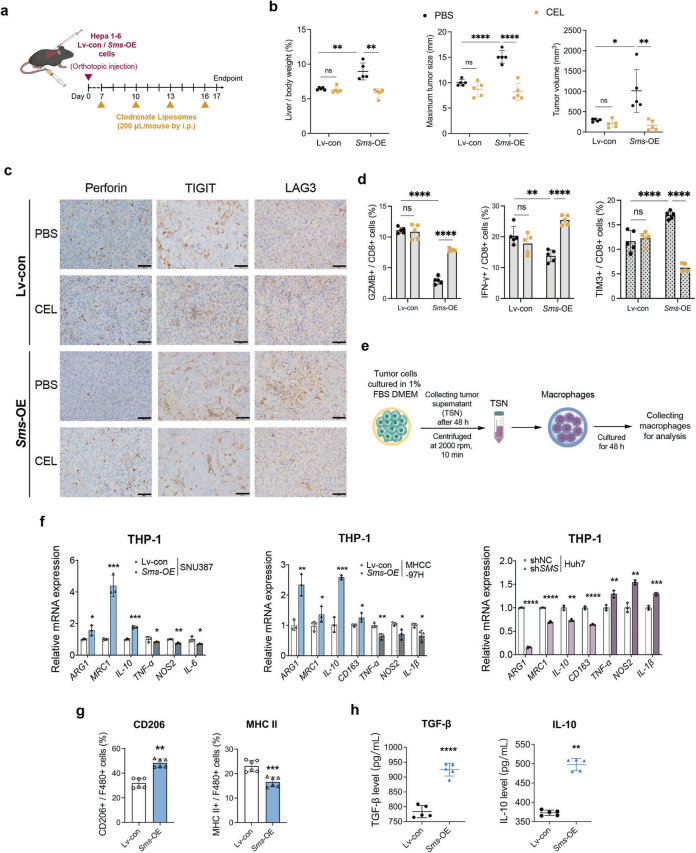
To investigate whether SMS acts by regulating macrophages, the authors depleted macrophages in vivo with clodronate disodium liposomes and found that macrophage clearance effectively rescued the tumor-promoting effect of SMS overexpression while restoring the effector features of CD8+ T cells. When macrophages were cultured in tumor cell culture supernatant (TSN), they tended toward the M2 phenotype and the expression of M1 markers decreased. At the same time, the concentrations of TGF-β and IL-10, two representative chemokines produced by M2 macrophages, rose sharply in the macrophage supernatant. Further studies showed that SMS upregulation promotes the production and release of spermine, and targeted polyamine metabolomics showed that spermine levels were significantly reduced in macrophages cultured in TSN from SMS-knockdown tumor cells. To analyze whether spermine acts on macrophages, the authors applied exogenous spermine to macrophages and observed that it stimulated macrophage polarization toward M2 in a concentration-dependent manner. In addition, adding spermine effectively restored M2 polarization of macrophages co-cultured with SMS-deficient HCC cells. In vivo orthotopic tumor experiments showed that spermine supplementation significantly promoted tumor growth and macrophage polarization toward the M2 phenotype, indicating that SMS mainly stimulates macrophage M2 polarization through its metabolite spermine. Further studies showed that SMS-spermine triggers CD8+ T cell dysfunction via macrophages.
Figure 2. SMS in tumor cells promotes macrophage polarization toward the M2 phenotype
3. Blocking spermine sensitizes HCC to immunotherapy
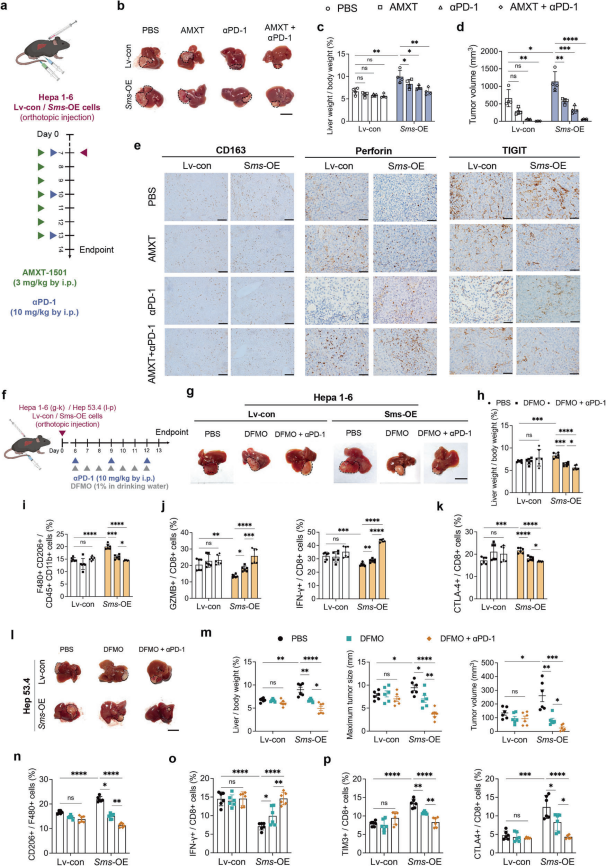
Further studies showed that SMS-spermine activates M2 polarization mainly by activating the PI3K-Akt-mTOR-S6K signaling pathway in macrophages. Previous studies have shown that spermine reprograms the TME by stimulating M2 polarization of macrophages, thereby suppressing CD8+ T cell function; the authors therefore further investigated whether blocking spermine could alleviate the immunosuppressive TME and act synergistically with immunotherapy in vivo. The polyamine transport inhibitor AMXT-1501 was administered with or without a PD-1 inhibitor (αPD-1) to orthotopic tumors formed by Hepa 1-6 cells with different SMS expression. Although each agent alone moderately inhibited the orthotopic tumor burden, the combination of AMXT-1501 and the PD-1 inhibitor produced the greatest tumor shrinkage in SMS-overexpressing tumors. Compared with monotherapy, the combination also significantly attenuated M2 polarization of TAMs and restored effector CD8+ T cells in the TME. These results were also verified in two other mouse models, indicating that inhibiting the production or transport of spermine may serve as an adjunct to immunotherapy for SMS-overexpressing HCC.
Figure 3. Blocking spermine enhances the efficacy of anti-PD-1 therapy in HCC
Conclusions
This study identifies SMS as a key regulator that builds an immunosuppressive TME mainly by promoting the macrophage M2 phenotype through its metabolite spermine, and suggests that blocking spermine may be an effective strategy for delaying HCC progression.