Chemical genetics is the use of genetic methods to modify certain biomolecules to interact with previously unrecognized small molecules, thereby regulating the activity of nerve cells, such as DREADDs (designer receptors exclusively activated by designer drugs).
DREADDs is a chemical genetics platform based on the modification of G protein coupled receptors. By modifying different G protein coupled receptors to deliver artificially synthesized proteins, the modified receptors can only be activated or inhibited by specially synthesized compounds, and activate the corresponding GPCR signaling pathway, thereby triggering different excitatory changes in cells.
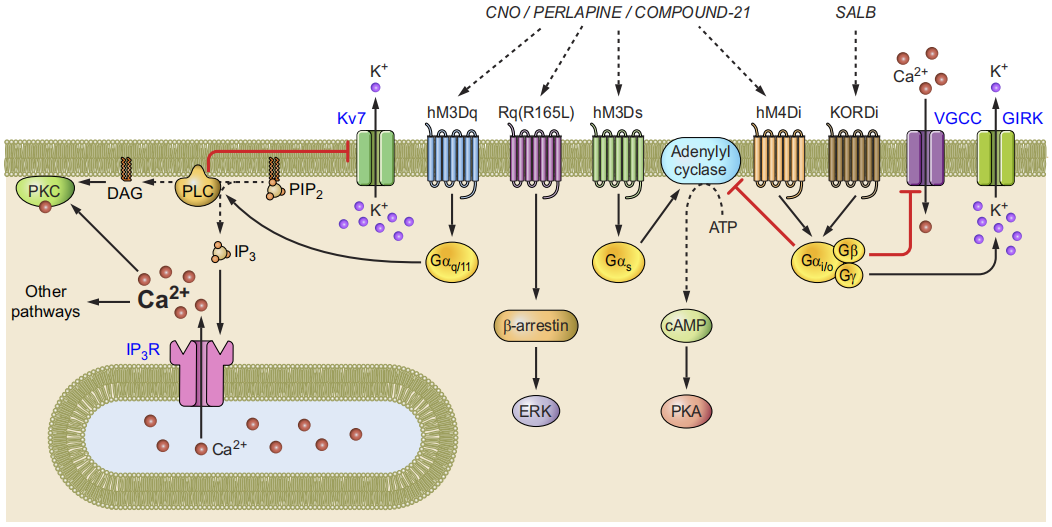
Intracellular signaling pathways corresponding to different DREADDS
(Deniz Atasoy and Scott M. Sternson..Physiol Rev. 2018)
Among them, DREADDs activated by clozapine-N-oxide (CNO) can selectively act on different GPC R-cascade reactions, including activating Gq, Gi, Gs, Golf, and β - arrestin, among which Gq DREADD and Gi READD are widely used.
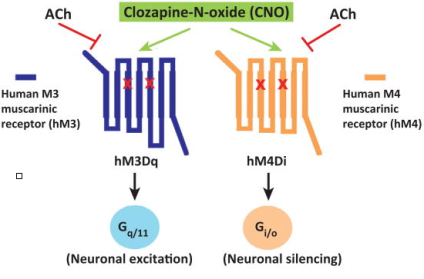
Under normal physiological conditions, the human muscarinic acetylcholine receptor subtype M3 (hM3) can bind to the endogenous neurotransmitter acetylcholine (Ach) and then couple with G protein coupled receptors of the Gq class, participating in the Gq class signaling pathway. The human muscarinic acetylcholine receptor subtype M4 (hM4) binds to acetylcholine (Ach) and interacts with Gi class G protein coupled receptors, participating in the Gi class signaling pathway.
The DREADD structures and G protein-coupled properties of hM3Dq and hM4Di
(Jürgen Wess et al, Trends Pharmacol Sci.2013)
However, when the two conserved sites A5.46G and Y3.33C on hM3 and hM4 were mutated (indicated by the red cross in the above figure), both no longer bind to acetylcholine but can efficiently bind to exogenously added CNO. Under CNO stimulation, HM3Dq plays a role in stimulating neurons, while hM4Di leads to neuronal inhibition. We refer to the mutated receptors as hM3Dq and hM4Di.
2、Research steps for DREAMDs
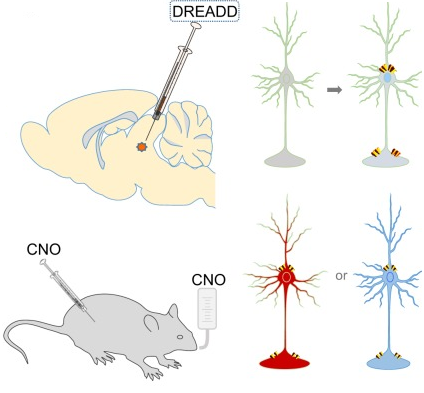
1. Select appropriate DREADDs receptors
2. Introducing the DREADD gene into animals through genetically modified animals or viral vectors;
3. Animal CNO administration (control time or dosage);
4. Detection of the effectiveness of DREADDs receptors and animal phenotype testing;
(Jingwei Jiang,et al. Am J Physiol Regul Integr Comp Physiol. 2017)
3、Application of DREAMDs technology
DREADDs technology provides neuroscientists with powerful new tools for mapping the neural circuits behind a large number of central nervous system (CNS) functions Using DREADDs technology, specific neurons can be turned on or off through temporal and spatial control, such as memory formation, food intake regulation, and wakefulness.
4、DREADDs Technology Strategy
The two common strategies for targeting the DREADD gene are virus injection and transgenic animal models. At present, recombinant AAV vectors carrying DREADD transgenes have been developed. By adding cell specific promoters and using stereotaxic injection, precise expression of the DREADD gene in different tissue cells can be achieved. By utilizing CRE, FLP and other technologies, further conditional expression of the gene can be achieved. For example, when you have CRE transgenic animals, you can directly use DIO vectors carrying DREADD transgenes. In addition, researchers can also use some special AAV serotypes to achieve reverse or cross synaptic infection of the virus.