CRISPR-gRNA Library Screening Coupled with Multi-Omics Analysis Uncovers Core Transcriptional Programs in Optic Nerve Degeneration
Custom AAV | Mouse gRNA AAV Library | In Vivo CRISPR Screening of Core Neurodegeneration Programs - WZBIO
Neurodegenerative disease is a chronic, progressive disorder of the nervous system, characterized mainly by distal axon injury and dying-back neuropathy; however, the pathway from axon injury to neuronal death remains incompletely understood. Changes in gene expression are an important manifestation of neural injury, and high-throughput in vivo screening of transcription factors to identify the key regulators of neuronal injury or axon regeneration is an effective strategy for studying neurodegenerative disease. CRISPR-gRNA library screening combined with multi-omics analysis provides a dual safeguard for large-scale genetic screening in vivo.
Paper title: Core transcription programs controlling injury-induced neurodegeneration of retinal ganglion cells.
Ready for direct AAV packaging and compatible with spCas9 AAV virus or spCas9 transgenic animals, enabling convenient in vivo knockout of target genes and functional studies of genes of interest
Product advantages
1. GFP fluorescent tag on the vector, for convenient monitoring of plasmid transfection efficiency; 2. Directly amenable to AAV packaging; 3. Compared with a single gRNA, the design of a 4-5 gRNA pool per target gene greatly increases knockout efficiency; 4. The complete mouse gRNA pool clone library is available, as well as various sub-libraries such as transcription factors, protein kinases, phosphatases, drug targets and membrane proteins. 5. All items are in stock, greatly shortening the research cycle.
Article summary
Most neurodegenerative diseases share the same pathological features, the most devastating of which is neuronal death; however, the regulatory programs governing neuronal death and axon regeneration in neurodegenerative disease remain poorly understood. To determine the mechanisms by which axon injury in the adult central nervous system leads to neurodegeneration, the researchers used an optic nerve crush (ONC) model, in which severing the axons of retinal ganglion cells (RGCs) causes ONC and thereby extensive RGC death and regenerative failure. Using CRISPR-gRNA library screening, the researchers performed a genome-wide screen of 1,893 transcription factors (TFs) to search for suppressors of RGC survival and axon regeneration after ONC, and at the same time analysed the epigenetic and transcriptional profiles of injured RGCs by ATAC-seq and RNA-seq, defining injury-responsive TFs and their targets. The results reveal the core transcriptional program that converts axon injury into neurodegenerative disease and propose new strategies for treating neurodegenerative disease.
Research Findings
1. CRISPR-gRNA Library Screening Combined with Epigenetic Analysis Identifies Negative Regulatory TFs for Neuronal Survival and Axon Regeneration
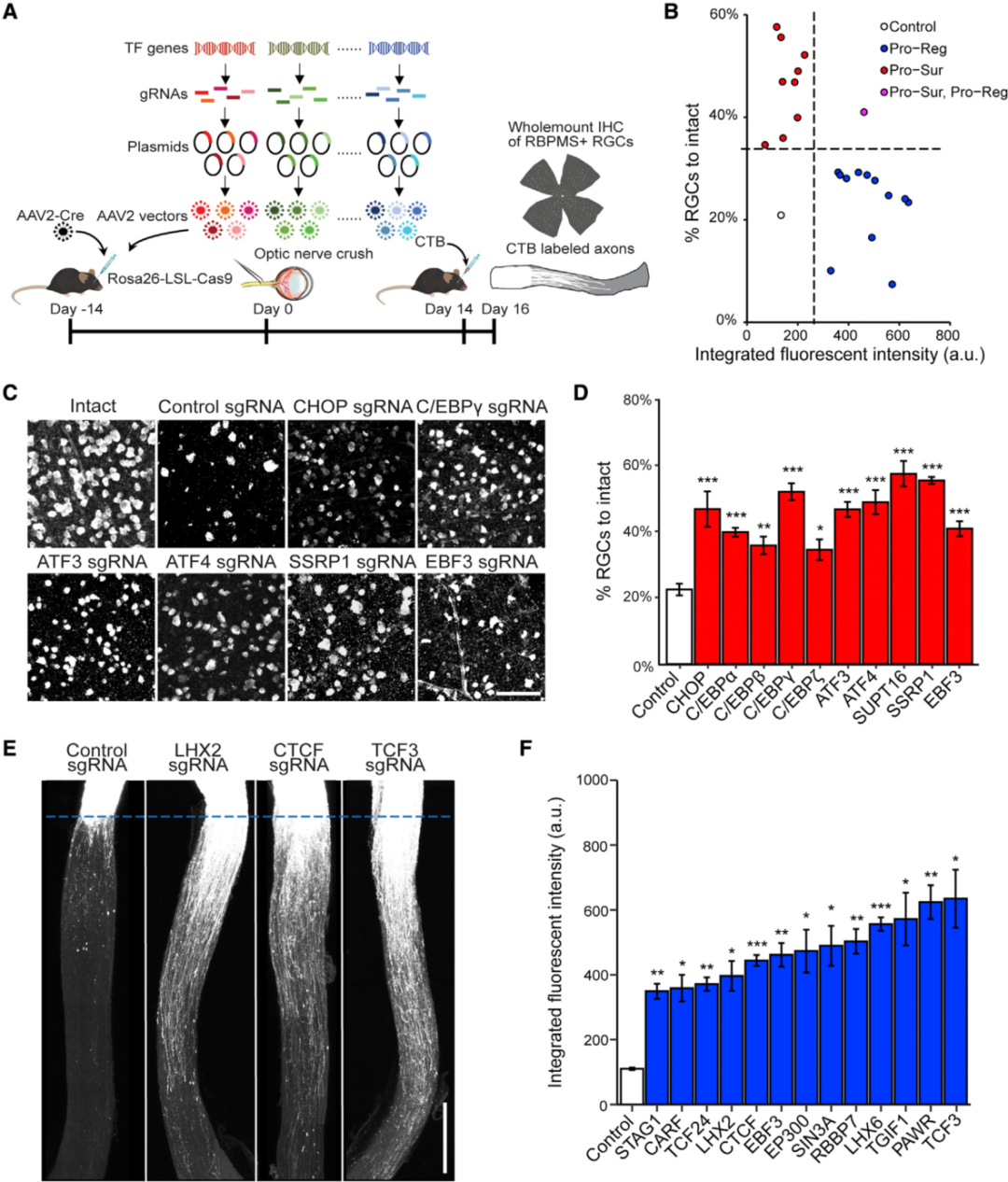
Using the RIKEN and TFCat databases, the authors compiled 1,893 TFs from the mouse genome, and for different regions of each TF gene selected five sgRNAs from the CRISPR-Cas9 knockout (GeCKO) library, which were then pooled and cloned into AAV2 vectors, establishing a library containing 1,893 AAV2-sgRNAs (with support from WZBIO). The sgRNAs and Cas9 were then introduced into RGCs via AAV2, and screening was performed two weeks after ONC to identify the TFs regulating neuronal survival and axon regeneration. The experiments identified 10 TFs that negatively regulate neuronal survival and 13 TFs that negatively regulate axon regeneration.
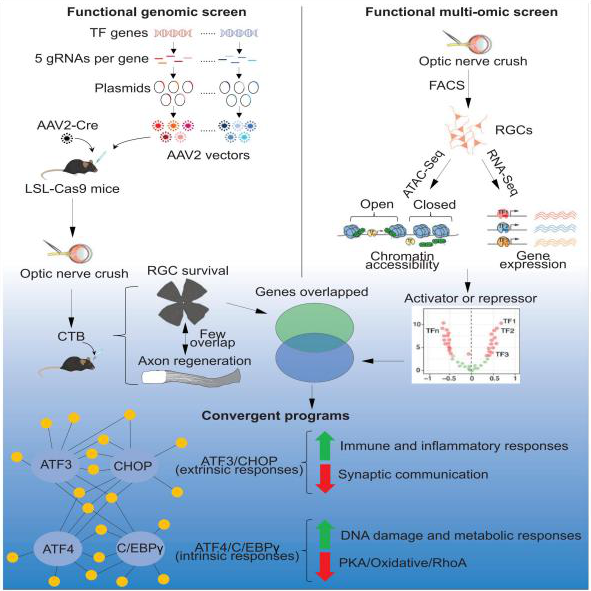
By integrating ATAC-seq, RNA-seq and TF footprinting data, four key TFs that negatively regulate RGC survival after injury were identified: ATF3, ATF4, C/EBPγ and CHOP. The authors then focused on the transcriptional programs regulated by these four key TFs, and found that ATF3/CHOP preferentially regulate pathways activated by cytokines and innate immunity, whereas ATF4/C/EBPγ regulate pathways activated by intrinsic neuronal stressors.
Figure 1. In vivo CRISPR screening identifies negative transcriptional regulators of RGC survival and axon regeneration after ONC
2. Key TFs in Injured RGCs Interact Functionally
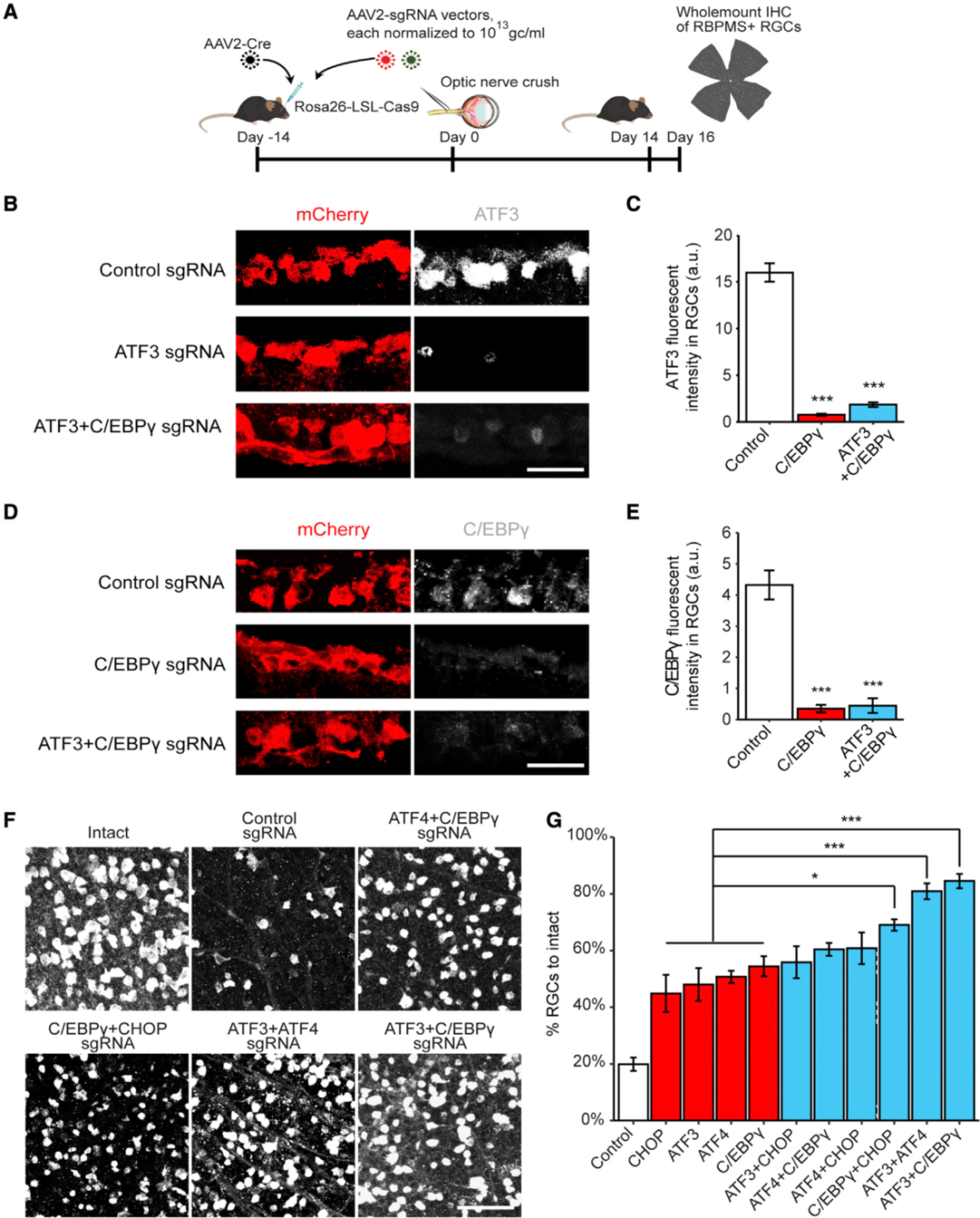
ATF3/CHOP and C/EBPγ/ATF4 act as two groups of negative transcriptional regulators of RGC survival and axon regeneration after ONC, and the authors hypothesized that, compared with knockout of a single TF, combined manipulation of TFs from both groups might exert additive effects and further improve RGC survival. The authors found that knockout of a single TF significantly improved RGC survival relative to the control group; compared with single-TF knockout, alternating combinations of TF knockouts (ATF3/C/EBPγ, ATF3/ATF4 and C/EBPγ/CHOP) significantly improved RGC survival; however, co-knockout of TFs within the same group (ATF3/CHOP or ATF4/C/EBPγ) showed no obvious protective effect.This indicates that ATF3/CHOP and ATF4/C/EBPγ activate two parallel pro-death pathways after neuronal injury, with overlapping and complementary actions between the two pathways.
Figure 2. Key TFs in injured RGCs interact functionally
Conclusions
Through independent in vivo genetic screening and multi-omics analysis of injured retinal ganglion cells, this study identified four key complementary regulators of neuronal survival after injury (ATF3, CHOP, ATF4 and C/EBPγ), which regulate two distinct degenerative programs in response to extrinsic and intrinsic stress.
In this study, the mouse gRNA AAV library was provided by WZBIO; for more viral packaging services, please contact us.
Contact Us
Have a question or need assistance? Our team is here to help. Fill out the form below, and we willrespond within 1-2 business days.